Crypto Algorithmic Trading in Australia: Complete 2026 Guide
Crypto algorithmic trading in Australia has moved well past the hobbyist phase. With roughly $50 billion in on-chain transaction volume recorded between March 2025 and February 2026, and around one in three Australian adults holding or having held a digital asset, the infrastructure for automated trading is genuinely here. The question is no longer whether algo trading is viable for Australians, but which tools, strategies, and compliance requirements actually apply to you.
> TL;DR: Crypto algorithmic trading in Australia uses computer programs to execute trades automatically based on pre-set rules. Key strategies include trend-following, arbitrage, and mean reversion, each with distinct risk profiles. Australian traders benefit from emotion-free execution and 24/7 market coverage, but must contend with AUSTRAC compliance, ASIC oversight, and ATO tax obligations on every single trade. Top platforms include Alpaca, Pepperstone, IC Markets, and local exchanges like Swyftx and Digital Surge.
What Is Crypto Algorithmic Trading in Australia?

Crypto algorithmic trading in Australia means using a computer program, connected to an exchange via API, to place buy and sell orders automatically based on pre-defined rules. Those rules might be as simple as “buy BTC when the 20-day moving average crosses above the 50-day average” or as complex as a multi-asset momentum model with dynamic position sizing. The program runs the logic, hits the exchange, and executes, without you staring at a screen at 2am.
The Australian market context matters here. Australia ranks 20th globally for total crypto value received among 95 countries analysed, which is meaningful for a country of 26 million people. That volume creates enough liquidity on major pairs for retail algo strategies to work without your orders moving the market.
It is worth being clear about what retail algo trading is and what it is not. When most Australians talk about crypto algo trading, they mean connecting a bot or custom script to an exchange like Swyftx, Kraken Pro, or Digital Surge via API, backtesting a strategy, and letting it run. That is meaningfully different from institutional high-frequency trading (HFT), which operates on co-located servers with sub-millisecond latency and is largely out of reach for retail traders regardless of geography.
The platforms available to Australians now include purpose-built algo brokers like Alpaca, CFD brokers with bot support like Pepperstone and IC Markets, and local exchanges with API access. The ecosystem is functional, if not as deep as what US or European traders access.
[INTERNAL LINK PLACEHOLDER: “best crypto exchanges Australia” → best-crypto-exchanges-australia]
How Algorithmic Trading Works in the Crypto Market
Every algo trading system, regardless of complexity, follows the same core loop: ingest market data, generate a signal, send an order, manage the position, and repeat. Understanding each step helps you identify where things can go wrong before you risk real capital.
Market data and signal generation come first. Your bot pulls price feeds, order book depth, volume data, or on-chain metrics from the exchange. It then runs that data through your strategy logic, which might be a simple moving average crossover or a statistical model comparing current price to a rolling mean. When conditions are met, a signal fires.
Order execution happens through the exchange’s API. Platforms like Kraken Pro, Swyftx, and Digital Surge all offer REST and WebSocket APIs that allow programmatic order placement. The quality of that API, specifically its rate limits, websocket stability, and order types supported, directly affects how well your strategy performs live.
Backtesting is where most retail algo traders spend the bulk of their early time, and for good reason. Running your strategy against historical OHLCV (open, high, low, close, volume) data tells you how it would have performed in the past. This is necessary but not sufficient. Backtests can be misleading if you do not account for slippage, exchange fees, or look-ahead bias.
Paper trading is the next step: running your live strategy against real market data but with simulated capital. Most serious platforms support this. It is how you catch bugs and logic errors before they cost you real money.
On latency: Australian traders are at a geographic disadvantage relative to servers in New York, London, or Tokyo. For most retail strategies, a 200-300ms round trip to a US-based exchange is irrelevant. For anything approaching HFT, it is fatal. Stick to strategies where execution speed is not the edge.
Python is the most common language used by retail algo traders globally, and Australia is no different. The `ccxt` library handles exchange connectivity across dozens of platforms. JavaScript and C++ appear for more performance-sensitive applications, but for most strategies running on hourly or daily timeframes, Python is perfectly adequate.
Main Types of Crypto Algorithmic Trading Strategies
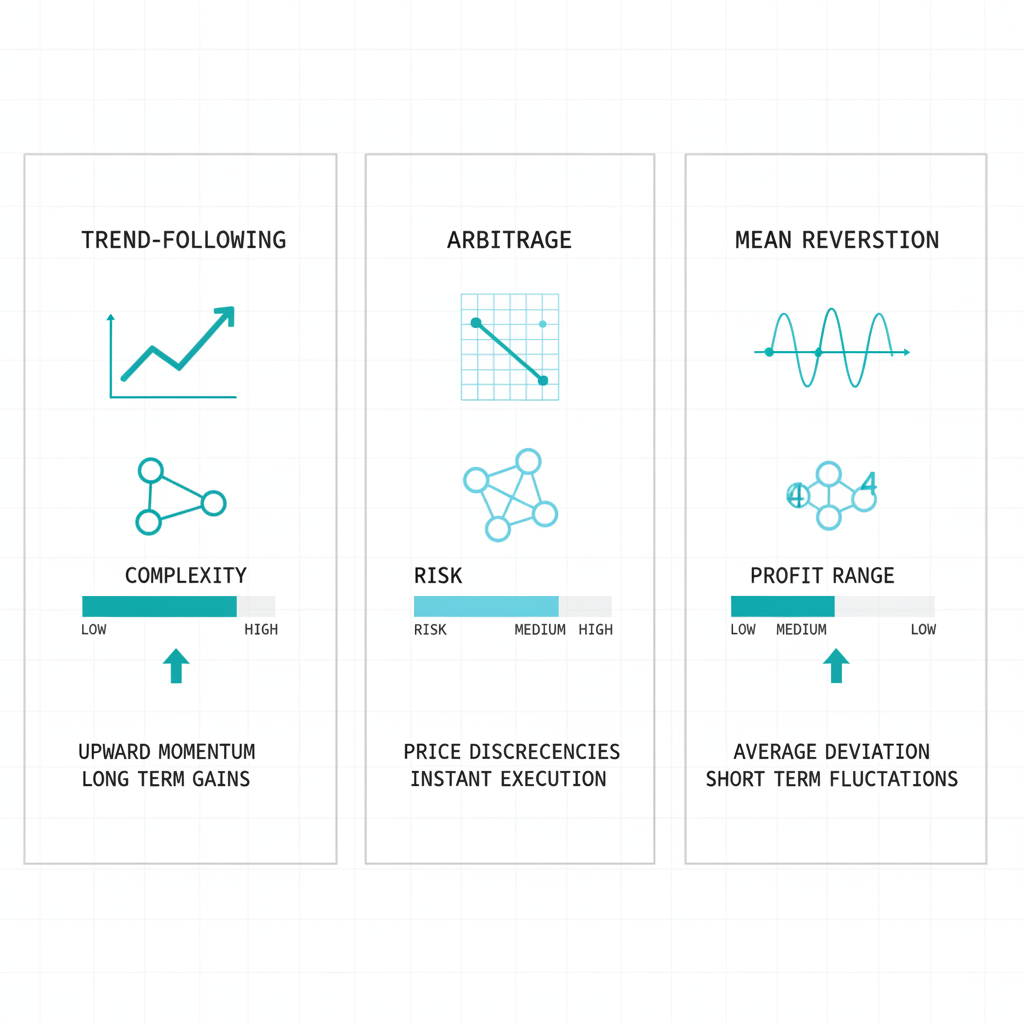
Trend-Following
Trend-following strategies assume that assets in motion stay in motion. A typical implementation might buy when a 20-period exponential moving average crosses above a 50-period EMA, and close the position when it crosses back. Breakout detection, where you enter when price moves beyond a defined range, is a close cousin.
The risk is obvious: trending markets are great, but choppy, sideways markets grind trend-following strategies to losses through repeated false signals. BTC and ETH have historically trended well over multi-week timeframes, which is why this remains the most popular retail algo approach.
Arbitrage
Arbitrage exploits price discrepancies for the same asset across different exchanges. If BTC/AUD is trading at $135,200 on one platform and $135,450 on another simultaneously, a bot can buy low and sell high, locking in the spread.
In practice, pure arbitrage is harder than it sounds. By the time your orders fill, the discrepancy is often gone. Fees, withdrawal times, and API latency erode margins quickly. Triangular arbitrage within a single exchange (exploiting pricing inconsistencies between three trading pairs) is more accessible but still competitive.
Mean Reversion
Mean reversion strategies bet that prices return to a historical average after deviating sharply. The Bollinger Band squeeze is a classic example: when price moves two standard deviations below the moving average, you buy, expecting a reversion to the mean.
This works well in range-bound conditions and poorly in sustained trends. The real risk is that what looks like a reversion setup is actually the start of a new trend, a problem that killed many mean reversion strategies during Bitcoin’s 2022 collapse.
Momentum Trading
Similar to trend-following but typically shorter-timeframe, momentum strategies enter in the direction of strong recent price moves. The logic is that assets that have performed well over the past 7-30 days tend to continue outperforming over the near term. Momentum strategies are sensitive to the lookback period chosen and tend to suffer badly at trend reversals.
Market Making
Market making involves placing simultaneous buy and sell limit orders on either side of the mid-price to capture the spread. A simple bot might place a bid 0.1% below mid and an ask 0.1% above, collecting the difference on each round trip.
This strategy requires sufficient liquidity, tight spreads, and careful inventory management. On a liquid pair like BTC/AUD, competition from professional market makers is fierce. On smaller altcoin pairs, the spread is wider but volatility risk increases sharply.
High-Frequency Trading
HFT in crypto is almost entirely institutional territory in Australia. It requires co-located servers, direct market access agreements, and order execution measured in microseconds. Retail traders without dedicated infrastructure should not pursue this category. It is mentioned here for completeness, not as a recommendation.
Benefits of Automated Crypto Trading for Australian Traders
The single most practical benefit of automated crypto trading for Australians is the 24/7 coverage problem it solves. Crypto markets do not close on weekends or Australian public holidays. A significant BTC move at 3am AEST is not a theoretical risk, it happens regularly. A well-configured bot does not need to be woken up.
Speed is the second major advantage. When a signal triggers, an algorithm can send an order in milliseconds. A human trader watching the same chart might take 5-30 seconds to react, by which point price may have moved meaningfully, particularly in volatile conditions.
The emotional component is underappreciated. Holding a losing position longer than a strategy dictates, or closing a winning position too early out of fear, are among the most common ways retail traders underperform their own systems. Automated execution removes that variable. The algorithm does not feel anxious about a 15% drawdown.
Backtesting and forward testing give Australian traders something manual traders rarely have: a systematic way to refine strategy logic before deploying capital. Running a mean reversion system on three years of ETH/AUD hourly data takes minutes in Python and can reveal weaknesses that would otherwise only surface through expensive live losses.
Finally, scalability. One algorithm can simultaneously manage positions across BTC, ETH, SOL, and a dozen other pairs, monitoring conditions and executing consistently. A single human trader managing that breadth manually would degrade quickly in consistency.
Challenges and Risks of Crypto Algo Trading in Australia
Volatility and Strategy Failure
Crypto markets move fast and do not care about your backtested Sharpe ratio. A strategy that returned 80% annualised over three years of historical data can suffer a 40% drawdown in a week during a genuine market crisis. The 2022 LUNA/UST collapse and the FTX implosion created market conditions that broke strategies which had never encountered them in backtests.
Over-Optimisation
Curve-fitting, or over-optimisation, is where a strategy has been tuned so precisely to historical data that it effectively memorises the past rather than learning from it. The backtest looks extraordinary. Live performance is mediocre to terrible. The solution is out-of-sample testing: hold back a portion of your historical data and only test your final strategy on that unseen data before going live.
Security Risks
API key exposure is a genuine threat. If an attacker obtains a trading API key with withdrawal permissions, the damage is obvious. Even without withdrawal access, a compromised key can be used to churn your portfolio through unfavourable trades. Best practice is to use IP-whitelisted API keys with only the permissions your bot actually needs, and never store keys in plaintext in your codebase.
Exchange hacks remain a risk. The Australian regulatory environment does not provide deposit insurance equivalent to what bank deposits enjoy. Keeping only the capital your strategy needs on-exchange, and withdrawing profits regularly, is sensible risk management.
Infrastructure Risk
Server downtime, exchange API outages, and connectivity issues can cause a bot to miss trades, double-execute orders, or fail to close a losing position. Serious algo traders run their bots on cloud infrastructure (AWS, DigitalOcean) rather than a home PC, and build in error handling and alerting for when orders fail.
Regulatory and Scam Risk
The DFCRC estimated in March 2026 that Australia risks losing A$24 billion annually in economic gains from digital asset innovation without clearer regulatory frameworks. That uncertainty creates compliance risk for anyone building a business around automated trading.
On the scam side, in February 2026 Australian police charged a 42-year-old in connection with an alleged A$3.5 million investment scam that directed victims to a fake platform called “NEXOpayment”. ASIC has also initiated civil proceedings against NGS Crypto for operating unregistered managed investment schemes and specifically warned about the risks of using SMSFs to invest in crypto. If you are being pitched an automated trading system that promises guaranteed returns, the answer is no.
Australian Regulatory Environment: AUSTRAC, ASIC, and ATO
AUSTRAC
Digital currency exchanges operating in Australia have been required to register with AUSTRAC since 2018. That registration comes with anti-money laundering and counter-terrorism financing (AML/CTF) obligations: Know Your Customer (KYC) checks, ongoing transaction monitoring, and mandatory reporting of threshold transactions of A$10,000 or more.
AUSTRAC has not been passive about enforcement. It took action against Cryptolink for AML/CTF breaches, and operates a dedicated cryptocurrency taskforce focused on ensuring DCEs meet minimum standards. The scale of the problem is actually smaller than the headlines suggest: TRM Labs reported in March 2026 that less than 1% of Australian crypto transactions between March 2025 and February 2026 were linked to illicit actors. The regulatory infrastructure is working, even if it is still maturing.
For algo traders, the practical implication is straightforward: use registered DCEs. Running your bot against an unregistered exchange is a compliance risk, and if that exchange is subsequently shut down, getting your funds back becomes very difficult.
ASIC
ASIC monitors crypto exchanges and financial products. Its civil proceedings against NGS Crypto are a reminder that unlicensed managed investment schemes in crypto space are actively prosecuted. ASIC’s specific warning about SMSFs and crypto investments is worth taking seriously: self-managed super funds are allowed to hold crypto, but ASIC has flagged that many retail investors do not fully understand the risks they are taking on when they do.
For algo traders using CFD products, ASIC’s product intervention powers also apply. CFD crypto products are regulated, leverage limits apply, and providers must hold an Australian Financial Services Licence (AFSL).
ATO
Every crypto trade is a taxable event in Australia. That includes automated trades executed by your bot at 4am on a Saturday. The ATO treats cryptocurrency as property, meaning Capital Gains Tax (CGT) applies to disposal events. If you hold an asset for more than 12 months before disposing of it, you may be eligible for the 50% CGT discount, though high-frequency trading strategies are unlikely to hold positions long enough to qualify.
Income tax rules apply where the ATO determines you are carrying on a business of trading, rather than investing. The distinction matters for your tax rate and deductibility of losses.
The record-keeping obligation for algo traders is significant. Every trade your bot executes, including the acquisition price, disposal price, fees, and timestamp, needs to be recorded. Most exchanges provide CSV exports, and tools like Koinly or CoinTracking can import these and produce ATO-compatible reports. Given that an active algo strategy might execute hundreds of trades per month, manual record-keeping is not realistic.
[INTERNAL LINK PLACEHOLDER: “crypto tax Australia guide” → crypto-tax-australia]
Best Platforms for Crypto Algorithmic Trading in Australia (2026)
The right platform depends on what you are actually trying to do. A Python developer building a custom trend-following strategy on spot crypto needs something different from a trader who wants to run a pre-built Expert Advisor on BTC CFDs. Here is how the main options stack up.
Alpaca
Alpaca was identified as the best broker for algorithmic trading in Australia in 2026 following testing of over 100 brokers. The appeal is the developer experience: a clean REST and WebSocket API, commission-free US equity trading (crypto availability varies by region), and documentation that does not assume you are incompetent. Onboarding is smooth by institutional standards. For Australian developers building custom trading systems, it is the logical starting point.
Pepperstone
Pepperstone is ASIC-regulated and offers the cTrader platform with native cBot support. cBots are algorithmic trading scripts written in C#, and cTrader’s marketplace has a range of pre-built options. Spreads on major crypto CFDs are competitive, and the execution speed is strong. I have been using Pepperstone for CFD trading since 2022 and the platform stability has been consistently reliable.
IC Markets
IC Markets supports Expert Advisors through both MT4 and MT5, which means access to a large existing library of third-party trading bots. Spreads are among the tightest available from an Australian-accessible broker, with raw spread accounts starting from 0.0 pips on forex (crypto spreads are wider). Execution is fast, which matters for algo strategies that are sensitive to fill quality.
Interactive Brokers Australia
Interactive Brokers is the choice for algo traders who want broad asset coverage beyond crypto. The API supports Python, Java, C++, and C#, and the platform connects to global markets. It is not the most beginner-friendly option, but for systematic traders who want equities, futures, and crypto in one system, it is hard to beat.
Eightcap
Eightcap offers access to over 95 crypto CFDs and supports automation through MT4, MT5, and TradingView’s Pine Script strategy tools. The proprietary CryptoCrusher tool is worth exploring for traders who want a starting framework without building from scratch. It holds an ASIC licence,