Crypto Algo Trading in Australia 2026: Complete Guide
Crypto algo trading in Australia has moved well past the hobbyist phase. Traders running DCA bots on Swyftx, Python scripts against Interactive Brokers’ API, and Cryptohopper grids on BTC/AUD are no longer edge cases. They are a growing slice of the market, and the regulatory environment is finally catching up with them.
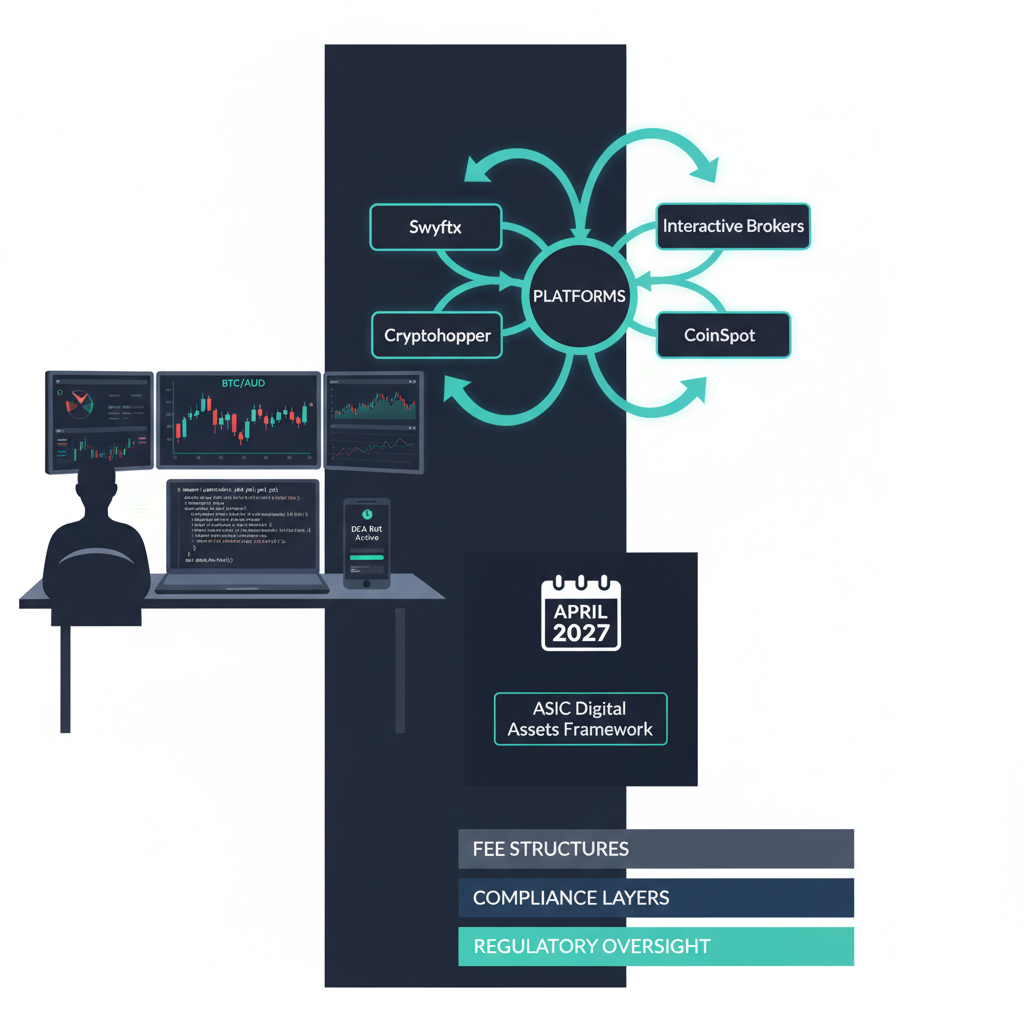
> TL;DR: Crypto algo trading in Australia lets you automate buy and sell decisions using pre-set rules or bots. Platforms range from Cryptohopper and Interactive Brokers to local exchanges like Swyftx and CoinSpot. ASIC’s new Digital Assets Framework kicks in April 2027, so regulatory compliance is a live issue right now. Fees vary widely, tax obligations are real, and choosing a platform that is AUSTRAC-registered matters.
What Is Crypto Algo Trading in Australia?
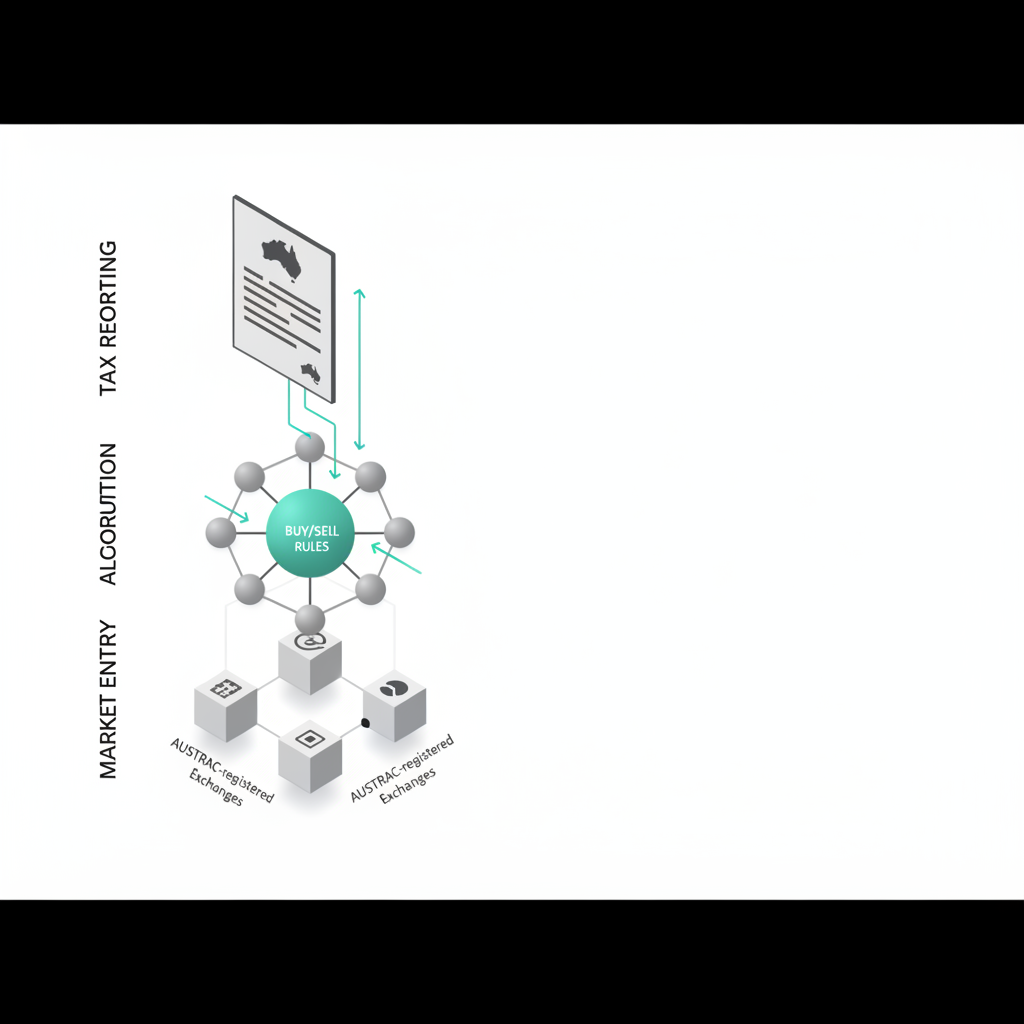
Crypto algo trading in Australia means using computer programs to execute trades automatically, based on mathematical rules and live market data, without you sitting at a screen clicking buy and sell. The program watches price, volume, order book depth, or whatever conditions you define, then fires orders the moment those conditions are met.
The systems range from the simple to the genuinely complex. At the simple end, you have rule-based bots: “buy $50 of ETH every Tuesday regardless of price” or “sell BTC if RSI crosses 70 on the 4-hour chart.” In the middle, you have DCA (dollar-cost averaging) bots that spread purchases over time to reduce timing risk. At the complex end, you have fully custom API-driven systems, the kind quant traders build in Python or Java and connect directly to exchange infrastructure through Interactive Brokers or Kraken’s REST API.
Australian traders are adopting automation for a few obvious reasons. Crypto markets run 24 hours a day, seven days a week, and nobody wants to watch BTC/AUD at 3am. Bots do not panic-sell during a flash crash or FOMO-buy during a weekend pump. Speed matters too: a well-configured algo can react to a signal in milliseconds; a human cannot.
The Australian context adds its own flavour. Local exchanges like Swyftx and CoinSpot offer AUD pairs, PayID deposits, and AUSTRAC registration that international platforms cannot guarantee. ASIC’s regulatory reach is expanding, with major legislation now passed and commencing in April 2027. Any serious Australian algo trader needs to understand both the mechanics and the compliance picture before going live.
This guide covers strategy types, the 2026 regulatory situation, platform comparisons, fees, tax obligations, banking friction points, and a step-by-step onboarding path.
How Crypto Algo Trading Works: Strategies Australians Use
The strategy you choose shapes everything: which platform you need, what fees you will pay, and how complex your setup has to be.
Market-making and arbitrage sit at the professional end. Market-making means posting both buy and sell orders around the mid-price and collecting the spread. Arbitrage means exploiting price differences across exchanges, buying BTC on one platform and simultaneously selling it where it trades higher. Both require fast execution, low fees, and usually direct API access. The margins are thin and the competition is serious.
Trend-following and momentum strategies are more accessible. These bots watch technical indicators like RSI (Relative Strength Index) or MACD and trade in the direction of the prevailing move. A basic example: go long ETH/AUD when the 50-day moving average crosses above the 200-day, exit when it crosses back. Cryptohopper and similar platforms let you build these without writing code.
DCA bots are probably the most widely used approach among Australian retail traders. You set a fixed amount (say, $100 AUD) to buy at regular intervals regardless of price. It removes the timing problem entirely. Platforms like Swyftx, CoinSpot, and Independent Reserve all support recurring buys in some form.
Copy trading is the easiest entry point. eToro lets you automatically mirror the portfolio moves of selected traders. Cryptohopper has its own copy trading marketplace. You bear the risk, but someone else runs the strategy.
Grid trading places a series of buy orders below the current price and sell orders above it, within a defined range. As price oscillates, the bot collects small profits on each completed pair. It works well in sideways markets and poorly in strong trends.
Before any of these go live, backtesting is not optional. Running your strategy against historical BTC/AUD or ETH/AUD data will surface whether it would have made or lost money in past conditions. It does not guarantee future performance, but it filters out obviously broken logic before real capital is at risk.
One important Australian-specific note: Binance Australia removed derivatives products for retail users following regulatory pressure. If your strategy relies on perpetual futures or leveraged products, your platform options narrow considerably. Stick to spot unless you qualify as a wholesale investor.
ASIC and AUSTRAC Regulation: What Crypto Algo Traders Must Know in 2026
This is the section that matters most right now, because the rules are actively changing.
The New Digital Assets Framework
The Corporations Amendment (Digital Assets Framework) Act 2026 passed on April 1, 2026, received Royal Assent on April 8, 2026, and commences on April 9, 2027. That one-year gap is a transitional window, not an excuse to ignore it.
Under the new framework, digital asset platforms (DAPs) and tokenised custody platforms (TCPs) will be required to hold an Australian Financial Services Licence (AFSL). ASIC will issue new regulatory guidance and operational standards, with consultations beginning in Q2 2026. An industry advisory group and stakeholder roundtables are part of the process.
ASIC has also extended its INFO 225 sector-wide no-action position until June 30, 2026. This means ASIC will generally not take enforcement action against platforms that are making genuine efforts to comply during the transitional period. After June 2026, that grace ends, and the lead-up to April 2027 will bring increasing scrutiny.
For algo traders, the practical implication is this: the platforms you connect your bots to need to be compliant. Using an unlicensed or non-AUSTRAC-registered exchange to run automated strategies is a risk that compounds as enforcement picks up.
AUSTRAC Obligations
AUSTRAC registration is mandatory for all crypto exchanges operating in Australia. Every legitimate platform, whether it is Swyftx, Kraken, or Coinbase, must be registered and comply with Anti-Money Laundering and Counter-Terrorism Financing (AML/CTF) obligations. This means Know Your Customer (KYC) verification, transaction monitoring, and suspicious matter reporting.
AUSTRAC has been public about a rise in crypto use for criminal activity in Australia. Operation Spincaster, a joint effort with the Australian Federal Police, identified approximately $162 million in losses linked to crypto scams affecting thousands of Australian wallets. Platforms with weak AML controls are on the watchlist.
Your Practical Compliance Checklist
Before connecting any bot or algo system to a platform, confirm three things. First, verify the platform’s AUSTRAC registration on the AUSTRAC public register. Second, check whether it holds an AFSL or has applied for one under the new framework. Third, read the Product Disclosure Statement (PDS) if one is available, particularly for any platform offering derivatives, margin products, or managed strategies.
Crypto algo trading in Australia is legal and accessible. It just requires using regulated infrastructure.
Best Platforms for Crypto Algo Trading in Australia 2026
No single platform wins across every use case. The right choice depends on whether you want a turnkey bot solution, direct API access for custom code, or a local AUD exchange to connect a third-party tool to.
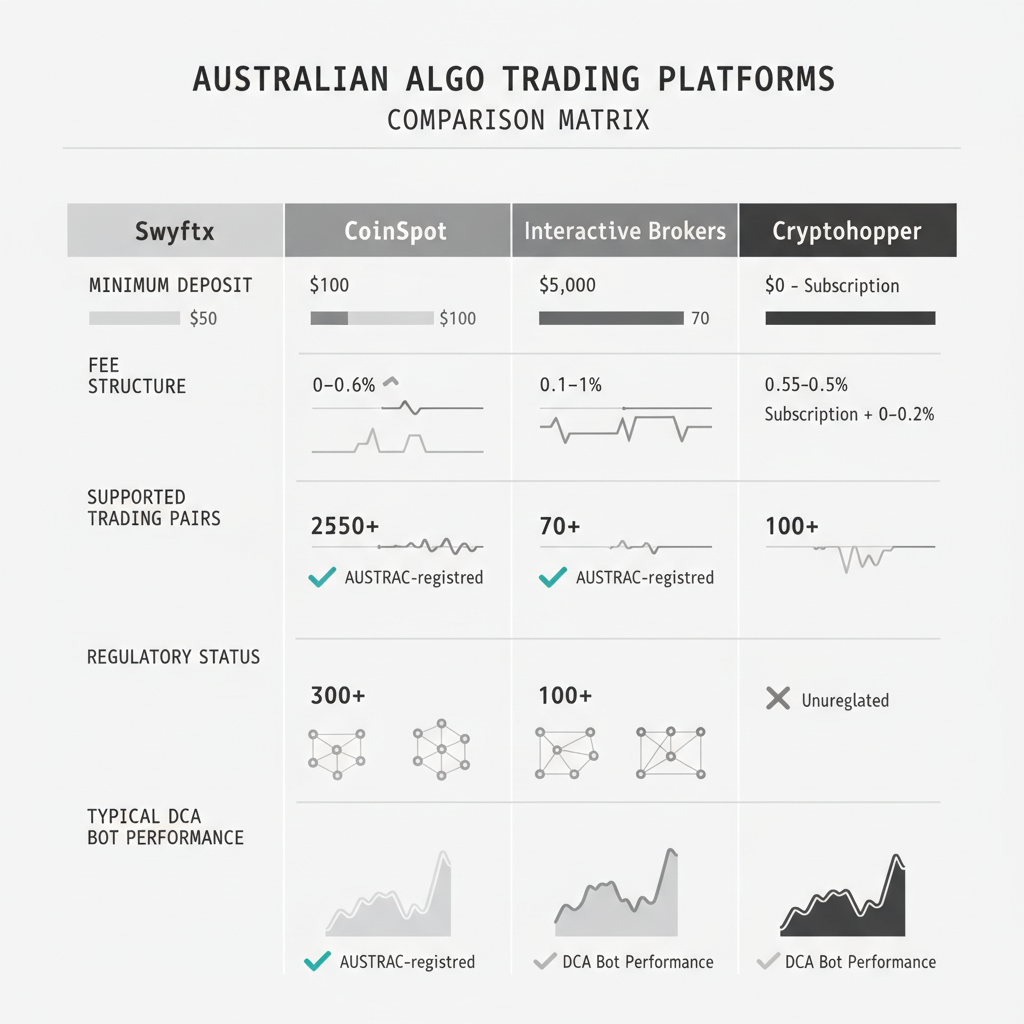
Comparison Table
| Platform | AUSTRAC Registered | Algo/Bot Support | AUD Deposits | Trading Fees | API Access | Best For |
|---|---|---|---|---|---|---|
| Cryptohopper | N/A (third-party tool) | Native (bots, DCA, grid, copy) | Via connected exchange | Subscription-based | Yes (connects to exchanges) | Mid-level algo traders |
| Interactive Brokers AU | Yes (AFSL holder) | Full custom API | Yes | From 0.1% | Full (Python, Java, C++) | Advanced quants |
| eToro | Yes | Copy trading | Yes | Spread-based | Limited | Copy trading beginners |
| Pepperstone | Yes (AFSL 414530) | MT4/MT5, cTrader, cBots | Yes | From 0.0% raw spread | Yes (EAs, cBots) | CFD algo traders |
| Binance | Yes | API, third-party bots | Yes | 0.1% spot | Full REST/WebSocket | Spot algo, large asset range |
| Swyftx | Yes | Demo mode, API (basic) | Yes (PayID, free) | ~0.6% spread on BTC/AUD | Yes | Australian beginners to mid |
| CoinSpot | Yes | Limited native; third-party via API | Yes (PayID, BPAY) | 0.1% market; 1% instant | Yes | Long-term DCA, local trust |
| Kraken | Yes | Full API, bot-compatible | Yes (AUD) | Maker 0%, Taker from 0.1% | Full REST/WebSocket | Fee-conscious algo traders |
Platform Rundown
Cryptohopper is the most accessible dedicated algo platform for Australians who do not want to write code. It connects to major exchanges via API and offers DCA bots, grid trading, trailing stop-losses, AI-assisted strategy building, and a copy trading marketplace. You pay a monthly subscription for advanced tiers, not per-trade fees. It does not hold your funds; it just instructs your connected exchange.
Interactive Brokers Australia is the right choice if you are building custom systems in Python, Java, or C++. The API is comprehensive, execution quality is high, and the platform holds an AFSL. The interface is not beginner-friendly and the minimum account requirements reflect that. I have seen quant traders run genuinely sophisticated multi-asset strategies through IBKR that would be impossible on a retail crypto exchange.
eToro is primarily a copy trading platform. You pick traders to mirror, set allocation amounts, and the system handles everything else. AUD deposits are supported. The spread-based fee model means costs are embedded in execution rather than shown as a line item, so read the disclosure carefully.
Pepperstone focuses on CFDs and forex, with MetaTrader 4, MetaTrader 5, and cTrader all available. cTrader’s cBot framework is genuinely good for algorithmic strategy development. Spreads are tight on major pairs. Crypto CFDs are available, but remember these are derivatives, not spot holdings, and the regulatory position for retail CFD trading in Australia has its own complexity.
Binance offers spot trading with full API access and a large asset selection. Since the derivatives pullback for Australian retail users, it is a spot-only platform for most traders here. The API is well-documented and widely used with third-party bot platforms including Cryptohopper and 3Commas.
Swyftx is where I would point most Australian beginners who want to automate without deep technical setup. The demo mode lets you test strategies with paper money before risking real AUD, which almost no other local exchange offers. PayID deposits are free and usually instant. The API is functional but not as feature-rich as Kraken or Binance for high-frequency work. [INTERNAL LINK PLACEHOLDER: Swyftx review → /reviews/swyftx]
CoinSpot has 530+ assets, 2.5 million users, and a long track record in Australia. Market order fees at 0.1% are competitive. The instant buy/sell rate jumps to 1%, which catches people out when they do not check which order type their bot is using. Worth confirming before you automate.
Kraken has maker fees as low as zero at higher volumes, taker fees starting at 0.1%, AUD deposits and withdrawals, and 24/7 phone support. For cost-conscious automated traders running moderate to high volume, Kraken is worth serious consideration.
Fee Breakdown: True Cost of Crypto Algo Trading in Australia
The number on the fee schedule is rarely the number you actually pay. Automated traders need to understand every layer of cost because bots compound fees with every execution.
Trading Fees and Spreads
Maker fees (you add liquidity by placing a limit order) generally run 0.1% to 0.25% on most Australian-accessible platforms. Taker fees (you take liquidity with a market order) run 0.15% to 0.5%. CoinSpot charges 0.1% on market and OTC orders but 1% on instant buy/sell. Bitcoin.com.au runs a flat 1% regardless of order type. Kraken starts at zero maker and 0.1% taker at standard volume.
Spreads are the invisible fee. The spread is the gap between the best buy price and the best sell price at any moment. On BTC/AUD, spreads typically run 0.1% to 0.8% depending on market conditions and platform liquidity. They widen during volatile periods. A bot executing market orders during a high-volatility event could pay 0.5% spread on top of 0.3% taker fee, which is 0.8% per trade before anything else.
Deposit and Withdrawal Fees
Bank transfers and PayID deposits are free on Swyftx, CoinSpot, and Independent Reserve. Credit and debit card deposits cost more: CoinSpot charges 1.22%, and some international platforms charge up to 3.5% for card funding. For algo trading, where you may need to fund accounts regularly, always use bank transfer or PayID.
AUD withdrawals to Australian bank accounts are generally free. Crypto withdrawals carry network fees that vary by asset and blockchain congestion.
Bot Subscriptions and Rate Limits
Third-party algo platforms charge monthly subscriptions for advanced features. Cryptohopper’s pricing tiers escalate with the number of positions, exchanges, and strategy complexity. Budget this as a fixed cost alongside trading fees.
High-frequency strategies can also hit API rate limits. Most exchanges cap the number of requests per minute. If your strategy fires too many orders, it will start failing silently unless you have handled rate-limit responses in your code.
Real-World Cost Example
On a $10,000 AUD BTC trade: Kraken at 0.1% taker plus ~0.2% spread costs roughly $30. CoinSpot on an instant buy at 1% plus ~0.4% spread costs roughly $140. Swyftx with its ~0.6% spread on BTC/AUD costs roughly $60. The difference between platforms is not trivial at volume.
[INTERNAL LINK PLACEHOLDER: full exchange fee comparison → /compare/crypto-exchange-fees-australia]
Tax on Crypto Algo Trading Profits in Australia
The ATO treats crypto as property, not currency. Every disposal event, selling crypto for AUD, swapping one token for another, or gifting crypto to someone, is a taxable event that triggers a capital gains tax (CGT) calculation.
The 12-month CGT discount is real and valuable: if you hold an asset for more than 12 months before disposing of it, you can reduce the capital gain by 50% as an individual. Algo trading almost by definition works against this. A DCA bot that buys BTC weekly and a grid bot that cycles positions constantly will generate dozens or hundreds of disposal events per year, most with holding periods measured in days or hours. Every single one needs to be recorded.
This is where the record-keeping burden becomes genuinely significant. You need the acquisition date, acquisition cost in AUD, disposal date, disposal proceeds in AUD, and any fees paid. Exchanges do not always format this in a way the ATO accepts directly.
Tax software that integrates with Australian exchanges is essentially mandatory for anyone running bots at volume. Koinly and CryptoTaxCalculator both connect via API to major platforms and generate ATO-compatible reports. CryptoTaxCalculator was built in Australia specifically for this market and handles the edge cases that generic tools miss.
One more