Crypto Algo Trading Fees Australia: What Automating Your Trades Actually Costs
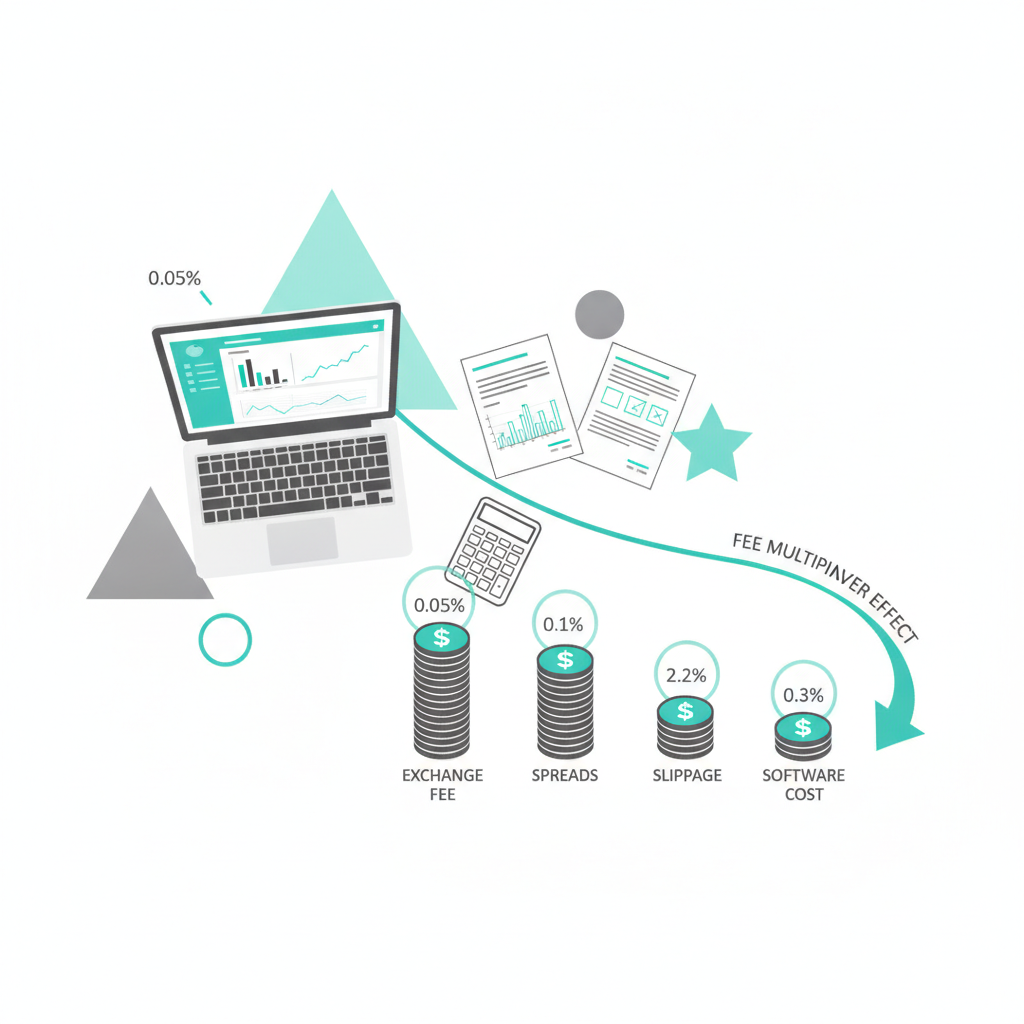
Crypto algo trading fees in Australia are the kind of thing that looks manageable on a spreadsheet until you run your first live bot for a month and check the numbers. The headline fee percentage on your exchange is real, but it is maybe a third of the actual cost story. The rest gets eaten quietly by spreads, slippage, software subscriptions, and a tax obligation that treats every automated trade as a separate CGT event.
> TL;DR
> Crypto algo trading fees in Australia extend well beyond the trading fee shown on your exchange dashboard. Between maker/taker spreads, bot platform subscriptions, VPS hosting, slippage on live fills, and the cost of tax software to handle hundreds of ATO-reportable events, the true all-in cost of running an automated strategy can easily run to 1.5–3% per round-trip trade. This guide breaks down every layer so you can size it up before your bot places its first order.
The Real Price of Automating Your Crypto Trades
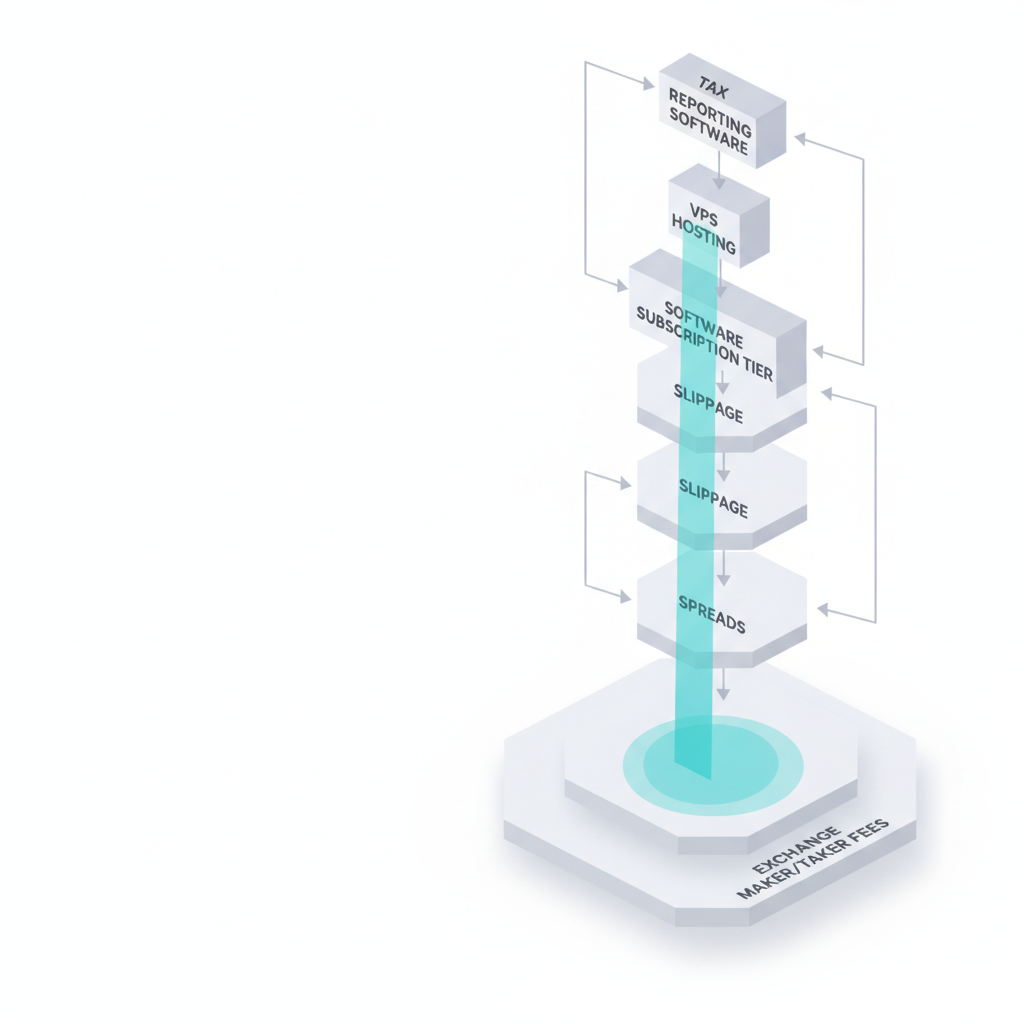
Most people who set up their first algo bot spend a lot of time thinking about strategy and almost no time thinking about cost structure. They see “0.1% trading fee” on Binance, think that sounds fine, and move on. What they miss is that a bot running an active strategy might place 200 to 500 trades per month. At that volume, a fee that looks trivial starts to compound into something that genuinely matters.
And that is just the trading fee. Spreads are a separate charge baked into the quoted price on many platforms. Slippage hits on volatile moves. The bot platform charges a monthly subscription whether or not the strategy makes money. If you are running your own code, you are probably paying for a VPS to keep it live 24/7. Then there is the ATO, which considers every crypto-to-crypto trade a taxable disposal, meaning a bot that fires 400 times a month is generating 400 CGT events you need to record and report. The tax software to handle that automatically is another line item.
None of these costs are hidden in a deceptive sense. They are just spread across different invoices and easy to ignore until they start showing up in your returns.
This guide works through each cost layer in order: exchange trading fees (maker/taker structures and what Australian platforms actually charge), spreads versus fees and why that distinction matters more than most people realise, bot platform and tooling costs, and finally slippage as the cost variable that backtests almost always underestimate.
Exchange Trading Fees: Maker, Taker, and What Australians Actually Pay
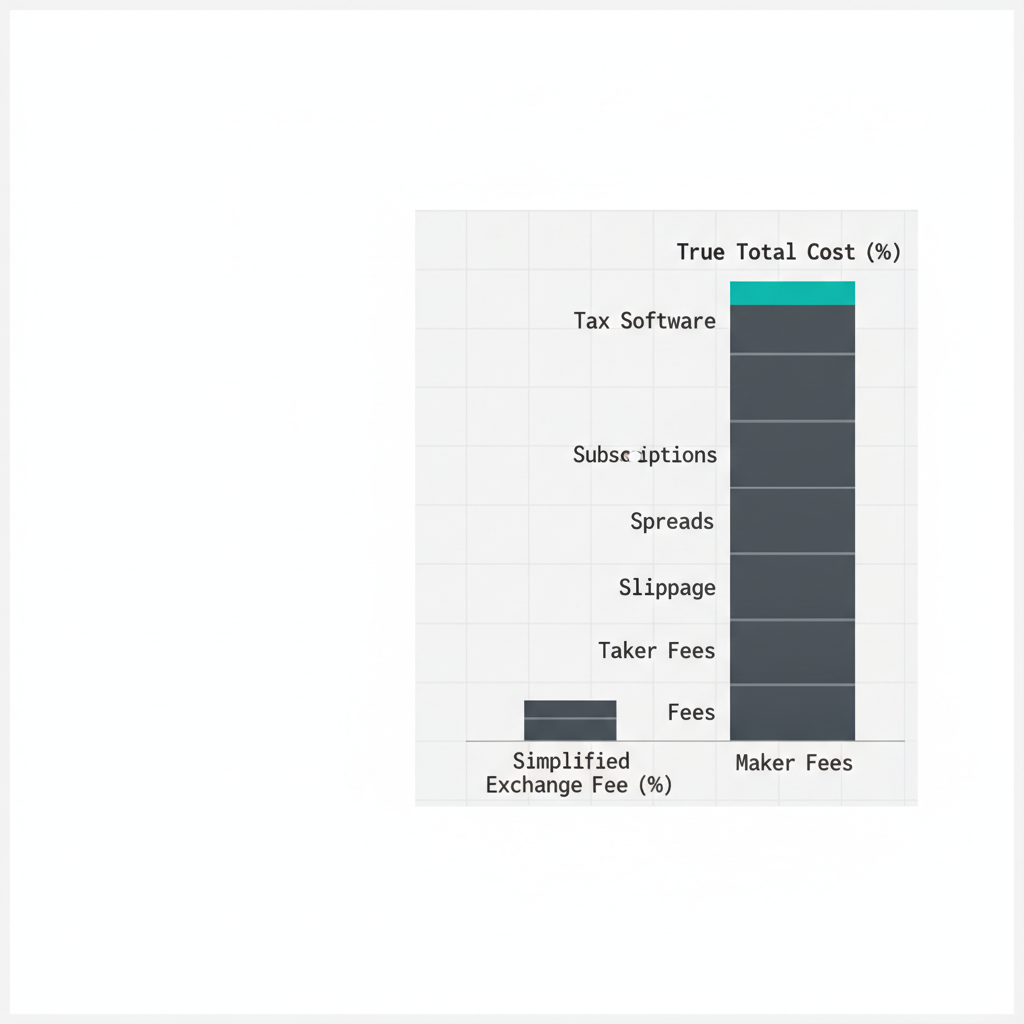
The maker/taker model is standard on any exchange with a proper order book and API access, which is what you need for algo trading. The distinction is simple: maker orders add liquidity to the order book (typically limit orders that sit and wait for a fill), and taker orders remove liquidity (market orders or limit orders that fill immediately against existing orders). Makers get rewarded with lower fees because they improve the market. Takers pay a premium because they are consuming it.
This matters for algo traders because well-designed bots almost always use limit orders to achieve maker status and reduce costs. A bot using market orders on every signal is paying the taker rate every single time, which adds up fast.
What Exchanges Actually Charge
Kraken charges 0.16% maker and 0.26% taker at the base tier. Binance charges 0.1% on both sides at standard tier, dropping to 0.075% with a BNB fee discount applied. CoinSpot runs a flat 0.1% on its pro market (the order book side), but its instant buy feature carries a spread of up to 1%, which is a different beast entirely. Independent Reserve and Digital Surge are both competitive on AUD pairs, with Independent Reserve sitting around 0.1–0.5% depending on volume tier. Swyftx does not use a traditional maker/taker model at all — it operates on a spread basis of roughly 0.5–1% depending on the asset, which I will cover properly in the next section.
Volume-tiered fee structures are worth understanding if your bot is active. On Kraken, once you hit USD 50,000 in 30-day volume, maker fees drop to 0.14%. At USD 1 million, they drop to 0.08%. A bot generating meaningful volume can work its way down these tiers and meaningfully reduce per-trade cost. It is one area where algo traders with sufficient capital actually have an edge over manual traders who trade sporadically.
The Binance AUD Problem
Binance is worth flagging separately. The trading fees are among the lowest available globally, and the API is well-documented, which makes it attractive for algo setups. But several major Australian banks have restricted or blocked transfers to Binance’s local entity over recent years, and the AUD deposit and withdrawal situation has been genuinely inconsistent. I have spoken to traders who hit delays on withdrawals that were long enough to affect their strategy. If your bot is running on Binance and you hit a banking friction point at the wrong moment, that friction has a real cost in missed trades and time.
Withdrawal fees are also worth factoring in. If your bot strategy involves rebalancing across multiple wallets or withdrawing profits regularly, the per-withdrawal network fees on most exchanges are fixed costs that stack up, particularly on congested networks.
Spreads vs Fees: The Hidden Cost Most Algo Traders Overlook
A trading fee is a separate charge shown explicitly on your trade receipt. A spread is different: it is the gap between the buy price and the sell price, and on many platforms it is baked silently into the quoted price rather than shown as a line item. You never see a spread fee charged. You just get a slightly worse price than the mid-market rate, every time.
On order-book exchanges, spreads are set by the market, not the platform, and for liquid pairs like BTC/AUD or ETH/AUD they are typically tight, often under 0.1% in normal conditions. On instant-buy platforms, the exchange sets the spread itself, and it is considerably wider. CoinSpot instant buys carry spreads that can sit between 1–2% depending on the asset. Swyftx runs around 0.5–1% on its spread model for most major assets.
That might sound acceptable for a one-off purchase. For an algo bot, it is a serious problem.
The Maths on Round-Trip Spread Cost
Every complete trade cycle, a buy and then a sell, is a round-trip. If you pay a 0.5% spread on entry and 0.5% on exit, your round-trip spread cost is 1%. A bot making 200 trades per month on a $1,000 position is paying $1,000 per year in spread costs before a single dollar of alpha is generated. That is 100% of the position value gone to spread in twelve months. On a $10,000 position it is 10% per year. Still significant, and still before fees, slippage, or tooling costs.
For this reason, algo traders need to be on order-book exchanges with API access, not instant-buy platforms. Kraken, Binance, Independent Reserve, and Digital Surge all offer proper order books and API connectivity. The spread on BTC/AUD on Kraken during normal market hours is typically under 0.1% at the mid-market level. That is the environment a bot needs to operate in profitably.
Slippage on volatile altcoin pairs is a related issue on order-book exchanges, particularly for smaller positions on less-liquid assets. Even with a tight quoted spread, a large order or a fast market can move the fill price against you. Sticking to high-liquidity major pairs reduces this risk considerably.
Bot Platform and Subscription Costs: What You Pay to Automate
Software costs are the most predictable part of the algo trading cost structure, and yet they are the part most people underestimate when sizing up whether a strategy is worth running.
Hosted Bot Platforms
Platforms like 3Commas and Cryptohopper handle the bot infrastructure for you: cloud hosting, interface, pre-built strategy templates, exchange connectivity. The trade-off is a monthly subscription fee. 3Commas starts around USD 37/month for its basic plan and goes up from there depending on the number of active bots and features. Cryptohopper’s Explorer plan sits around USD 19/month. Pionex is different, offering free built-in grid and DCA bots funded by taking a small cut of trading fees, which makes it worth examining if you want zero subscription cost.
TradingView is the tool most Australian algo traders using Pine Script will need. The Essential plan covers basic alerts, but if you are running a strategy that needs to fire webhooks at high frequency, you need at minimum the Plus plan (around USD 22.95/month billed monthly) or the Premium plan. Lower-tier plans cap the number of simultaneous alerts, which breaks active algo strategies quickly.
UltraAlgo sits at USD 67/month for its entry-level paid plan, which provides pre-built algo signals rather than a development environment. Worth considering if you want signals without building from scratch, but it is a significant subscription cost relative to most trading capital sizes.
Open-Source Alternatives
Freqtrade and Hummingbot are both free and genuinely capable. Freqtrade is a Python-based framework I have spent considerable time with, and it handles backtesting, live trading, and exchange API connectivity well. Hummingbot is stronger on market-making strategies. The cost is technical: you need to be comfortable with Python, command line, and basic server management.
Running either of these requires a VPS or cloud instance to guarantee 24/7 uptime. A local machine going to sleep or losing internet connectivity will break a live bot at exactly the wrong moment. A basic VPS on Digital Ocean or AWS Lightsail runs USD 4–12/month depending on specs, which is a reasonable cost for what it provides.
The Capital Proportionality Test
A $50/month all-in tooling cost sounds cheap in absolute terms. On a $2,000 trading portfolio, that is $600 per year, or 30% of capital consumed by software costs before you make a single trade. Your strategy needs to generate at least 30% annual return just to break even on tooling. On a $20,000 portfolio, the same $600 is 3%, which is a much more manageable hurdle.
This is not an argument against smaller accounts running algo strategies, but it is an honest sizing question worth answering before committing to a paid platform.
Slippage and Execution Risk: The Cost You Can’t Always Control
Slippage is the difference between the price you expected to fill at and the price you actually got. It exists because markets move between the time your bot sends an order and the time the exchange executes it, and because for larger orders, filling through the order book consumes multiple price levels.
Bots using market orders are most exposed. A market order fills at whatever price is available, and in a fast-moving market that can be meaningfully worse than the last-traded price. Limit orders solve the slippage problem but introduce a different risk: non-execution. If the price moves away before your limit order fills, the trade is missed entirely. Depending on the strategy, that missed trade can be as costly as a bad fill.
Why Backtests Lie About Slippage
This is the part that genuinely catches people out. Most backtesting environments, including TradingView’s strategy tester and Freqtrade’s backtesting module, assume fills at the close of the bar. In reality, by the time the bar closes and your signal fires, the price has already moved. This is a form of look-ahead bias, and it systematically overstates strategy performance.
[INTERNAL LINK PLACEHOLDER: look-ahead bias in backtesting → /guides/backtesting-pitfalls-australia]
The gap between backtest performance and live performance is often described as “strategy decay,” but a significant portion of it is simply slippage and realistic execution costs that the backtest did not model. I have seen strategies that showed 40% annual returns in backtesting produce 8% live, and the difference was almost entirely execution friction.
For Australian traders running bots on smaller altcoin pairs, slippage can easily run 0.5–1% per trade due to lower order book depth. On a major pair like BTC/AUD on Kraken, slippage on a reasonably sized order in normal conditions might be 0.05–0.1%. The difference is significant.
The practical fix is to build slippage assumptions into your backtest explicitly. In Freqtrade, you can set a slippage assumption in the configuration. In TradingView, you can adjust the commission field to include an estimated slippage buffer. At minimum, add 0.1–0.3% per trade to your backtest assumptions. For lower-liquidity pairs, double that and see whether the strategy still makes sense.
[INTERNAL LINK PLACEHOLDER: crypto trading bot tax Australia → /guides/crypto-trading-bot-tax-australia]
How the Costs Stack Up: A Realistic Summary Table
| Cost Component | Low Estimate | High Estimate | Notes |
|---|---|---|---|
| Exchange maker fee (per trade) | 0.08% | 0.26% | Varies by exchange and volume tier |
| Spread cost (round-trip) | 0.1% | 2.0% | Order-book pairs vs instant buy |
| Slippage (per trade) | 0.05% | 1.0% | Major pairs vs altcoin pairs |
| Bot platform subscription | $0/month | $100+/month | Free open-source vs hosted |
| TradingView plan | $0/month | ~$60/month AUD | Free tier vs Premium |
| VPS hosting | $5/month | $20/month | Required for 24/7 uptime |
| Crypto tax software | $50/year | $400+/year | Depends on trade volume and provider |
| Total per round-trip trade | ~0.25% | ~3.5% | Before fixed monthly costs |
The tax software line is one people consistently forget until their first EOFY with a bot running. A bot generating 300 trades per month produces 3,600 CGT events per year. You are not entering those manually. Koinly, CoinLedger, and CryptoTaxCalculator all offer Australian-specific CGT reporting and support API imports from major exchanges. Plans that cover unlimited transactions run from around $169 to $400+ AUD per year depending on the provider and your trade volume.
FAQ
What are the typical crypto algo trading fees in Australia?
The all-in cost for algorithmic crypto trading in Australia depends heavily on which exchange and tools you use. Exchange trading fees typically range from 0.1% to 0.26% per trade. Add spreads of 0.1–2% per round-trip depending on the platform, slippage of 0.05–1%, bot platform subscriptions of $0–$100+/month, and tax software costs. For an active bot on a reputable order-book exchange like Kraken or Independent Reserve, a realistic all-in per-trade cost lands between 0.3% and 0.8% before fixed monthly expenses.
Is algorithmic trading legal in Australia?
Yes. Trading your own account algorithmically is legal in Australia and requires no special licence. AUSTRAC registration applies to exchanges, not individual traders. Running an algo service for other people’s money is a different situation and triggers ASIC licensing requirements.
Do I have to pay tax on every trade my bot makes?
Yes. The ATO treats each crypto disposal, including crypto-to-crypto swaps, as a taxable event. A bot making 200 trades per month generates 200 separate CGT events. You need to track the cost base, proceeds, and any gain or loss on each one. Crypto tax software that integrates with your exchange API is effectively mandatory at that volume.
What is the cheapest way to run an algo trading bot in Australia?
Using an open-source framework like Freqtrade, hosted on a $5–10/month VPS, connected to a low-fee exchange like Kraken or Binance, is the lowest fixed-cost setup. You avoid subscription fees on the bot platform and TradingView. The trade-off is technical complexity: you need to build and maintain your own strategy code.
Why is slippage a bigger problem in backtesting than in live trading?
It is the reverse, actually. Slippage is typically worse in live trading than backtesting because most backtests assume fills at the bar close or at the exact signal price, which is almost never achievable in a live market. The backtest overstates performance; live trading reflects reality.