Crypto Algo Trading in Australia 2026: Complete Guide
Crypto algo trading in Australia has quietly shifted from a niche pursuit of quant nerds into something genuinely accessible to everyday traders, and the regulatory ground just moved significantly under everyone’s feet.
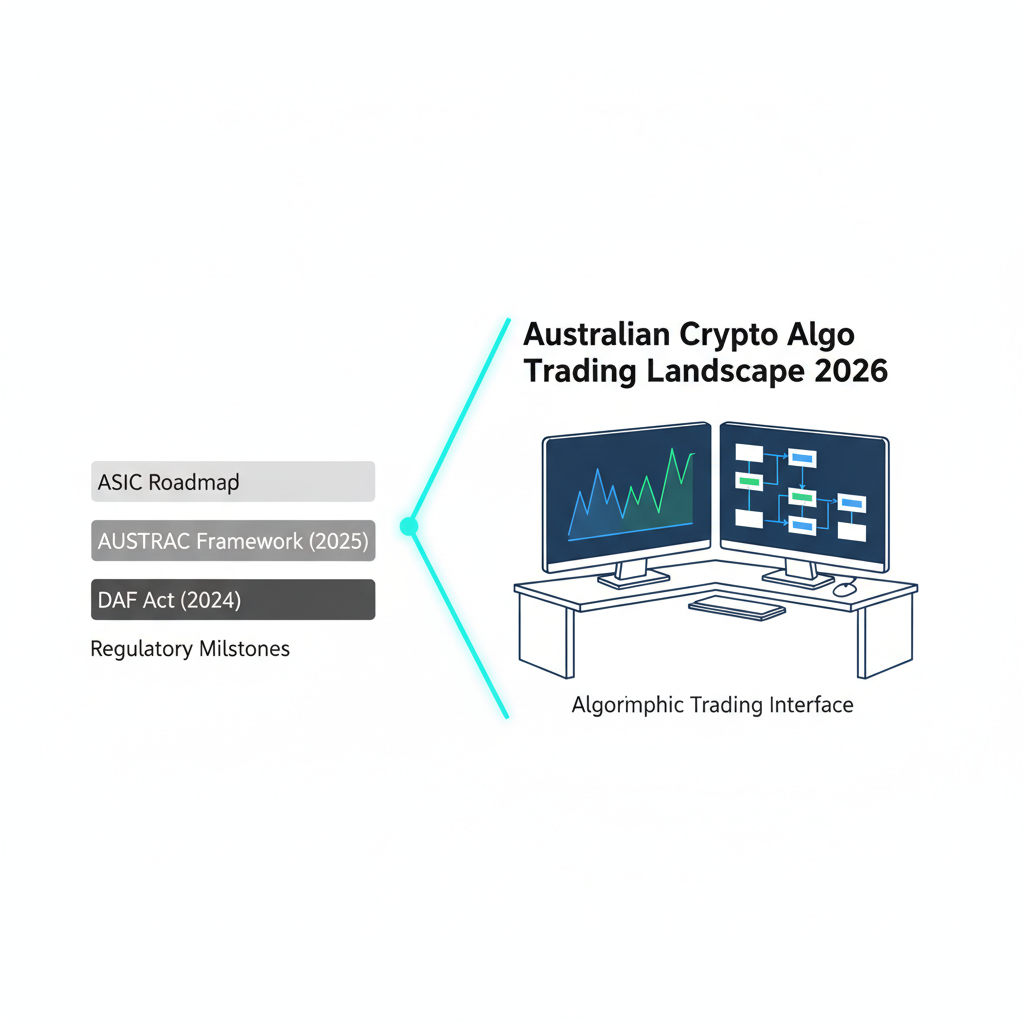
If you have been watching the space, you already know April 2026 was a big month. The DAF Act passed, AUSTRAC expanded its AML/CTF framework, Binance copped a $6.9 million fine, and ASIC dropped a roadmap that will reshape how every platform operating here is licensed. If you have not been watching, this guide will get you current.
What follows covers how algorithmic crypto trading actually works in an Australian context, which strategies are worth your time, how to backtest properly, and which platforms are genuinely viable for 2026, with the regulatory status to prove it.
> TL;DR: Crypto algo trading in Australia lets you automate strategies 24/7 using programmed rules, removing emotion from the equation. With the DAF Act 2026 now passed and AUSTRAC expanding AML obligations from April 2, the regulatory environment is changing fast. This guide covers the strategies, compliant platforms, tax obligations, and what you need to know before you deploy a single algo.
What Is Crypto Algo Trading in Australia?
Crypto algo trading in Australia refers to executing buy and sell orders automatically using computer programs built around predefined rules and mathematical models. Instead of sitting at a screen waiting for a moving average crossover, you write the rule once, test it, and let it run.
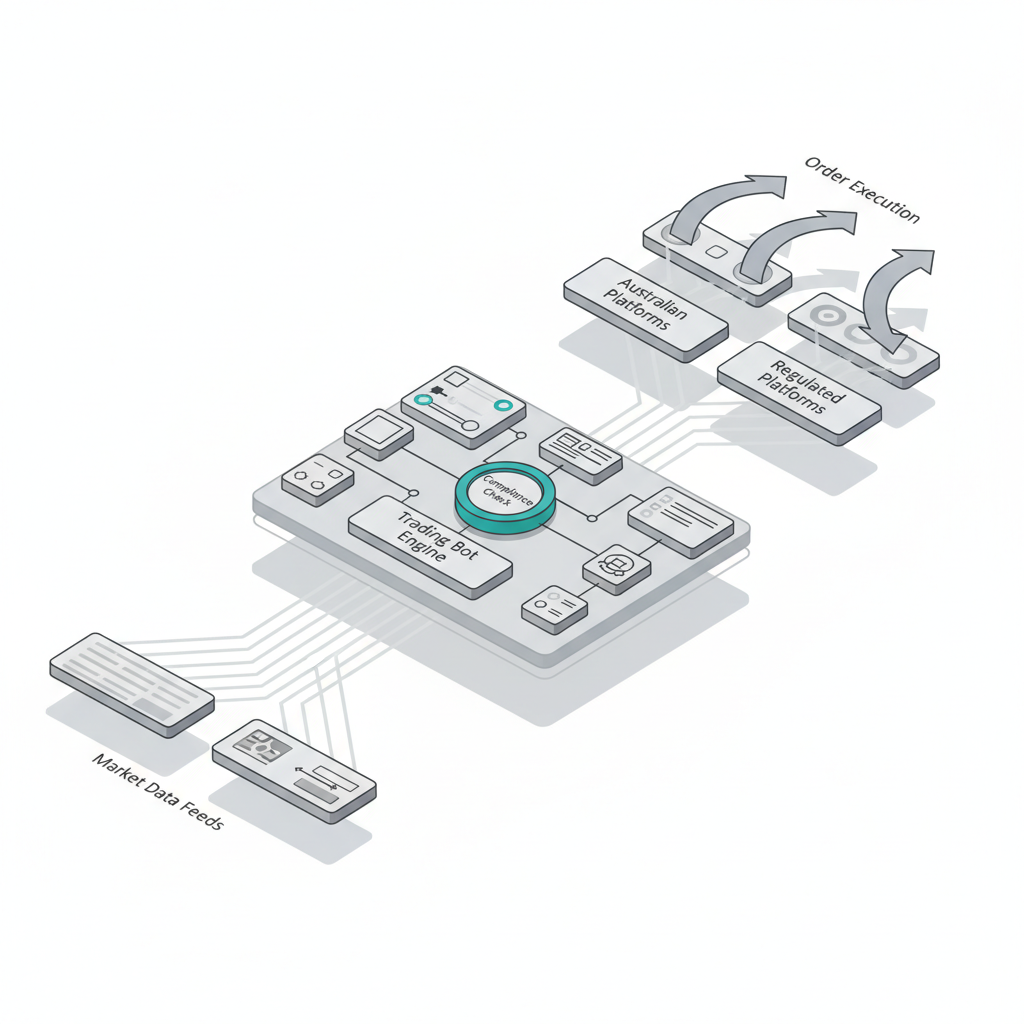
The mechanics are straightforward: your algorithm monitors price data, volume, order book depth, or any other input you define. When conditions are met, it sends an order to the exchange via API. The whole process can happen in milliseconds, which is the point.
Manual trading has obvious limits. You get tired, you second-guess yourself at 2am, you hesitate when the chart looks scary. Algorithms do not do any of that. The same rule fires the same way on Tuesday morning as it does on Sunday night, which matters because Australian crypto markets run around the clock, every day of the year. There is no closing bell.
That 24/7 reality is one reason algorithmic approaches suit crypto better than most other asset classes. You cannot realistically monitor BTC/AUD through every Asian trading session while also holding down a job. An algo can.
The market itself has enough depth to make this worthwhile. Over 2.5 million Australians currently hold crypto, and exchange liquidity on major pairs like BTC/AUD and ETH/AUD has grown accordingly. Thin markets punish algo traders with slippage; the current Australian market is mature enough that most standard strategies can execute without excessive friction.
On the regulatory side, both ASIC and AUSTRAC have jurisdiction here, and as of 2026 their reach has expanded considerably. The platform you trade on, and the way you interact with it programmatically, are both subject to compliance obligations. More on that in the regulations section below.
Key Benefits of Algorithmic Crypto Trading for Australian Traders
The speed argument gets cited constantly, but it is worth being specific. A well-built algo can respond to a price move in under a millisecond. A human trader, even a fast one, is looking at hundreds of milliseconds minimum from perception to execution. On volatile pairs or during news events, that gap is the difference between your entry price and something substantially worse.
Emotion-free execution is the less glamorous benefit that probably matters more in practice. Fear and greed are genuinely destructive to trading performance, and most traders underestimate how much both affect their decisions in real time. When your algo has a rule that says “exit if price drops 2% from entry,” it exits. It does not think “maybe it will bounce.” That consistency is worth a lot over hundreds of trades.
The 24/7 availability point is specific to crypto in a way it is not for equities. Australian stock markets close at 4pm AEST. BTC/AUD does not. Running a manual strategy through overnight Asian sessions is not sustainable, but automated crypto trading in Australia runs continuously without you needing to be present.
Backtesting is a genuine advantage that manual trading cannot replicate. Before you risk a dollar, you can run your strategy against years of historical OHLCV data and see exactly how it would have performed, including the drawdowns. That feedback loop accelerates strategy development significantly.
Scalability is the final piece. Running three separate strategies across BTC, ETH, and SOL simultaneously is trivial for an algo. Doing the same thing manually would require your full attention split three ways. Most serious algo traders end up running portfolios of strategies rather than relying on a single approach, and the infrastructure supports it.
Most Common Crypto Algo Trading Strategies Explained
Trend-Following
This is where most people start, and for good reason. The logic is simple: identify when an asset is in an established uptrend and go long, exit when the trend reverses. Moving average crossovers, ADX filters, and breakout systems all fall into this category. Trend-following strategies tend to perform well in the strong directional moves that crypto regularly produces, and they are relatively straightforward to code and backtest. The weakness is that they bleed in choppy, sideways markets, which crypto also regularly produces.
Arbitrage
Arbitrage exploits price discrepancies for the same asset across different venues. If BTC is trading at $95,200 AUD on Swyftx and $95,350 AUD on another exchange simultaneously, a fast enough algo can buy on the cheaper venue and sell on the expensive one, pocketing the spread. In practice, pure exchange arbitrage has become very difficult because everyone else is running the same play and the windows close in milliseconds. Triangular arbitrage within a single exchange, or statistical arbitrage across correlated pairs, tends to be more realistic for most traders.
Mean Reversion
Mean reversion strategies bet that when a price deviates significantly from its historical average, it will eventually return. Bollinger Band strategies and pairs trading fall here. These can work well in ranging markets but get destroyed in trending conditions, so they are effectively the mirror image of trend-following in terms of market suitability.
Momentum and Market Making
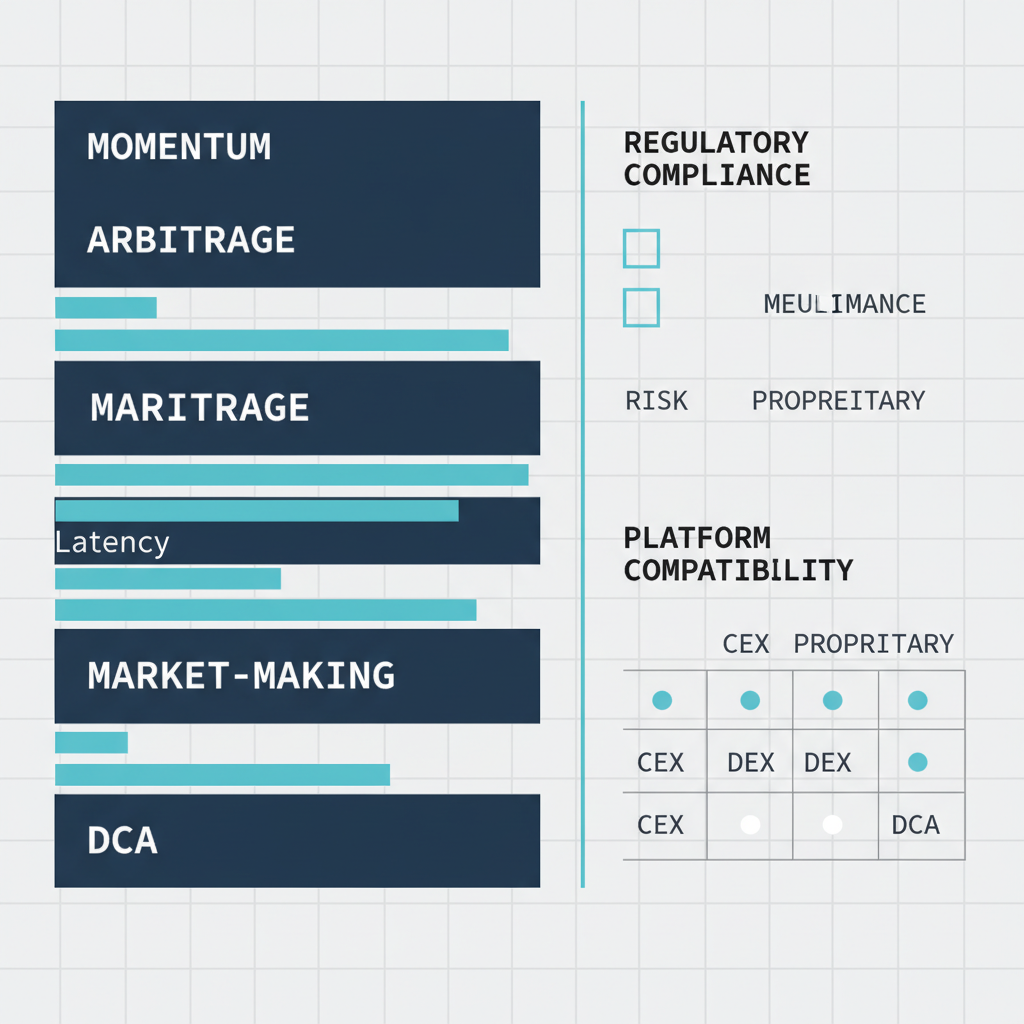
Momentum trading rides strong directional moves, entering after confirmation rather than waiting for a full trend to establish. It captures shorter-duration price impulses and suits faster-moving timeframes. Market making is a different beast entirely: you place simultaneous buy and sell limit orders on both sides of the order book, earning the spread repeatedly. It requires significant capital, tight risk controls, and low-latency infrastructure to do properly. On Australian spot exchanges with maker/taker fee structures, it can work, but it is firmly in the advanced category.
High-Frequency Trading
HFT involves executing very large volumes of orders in fractions of a second, profiting from tiny price movements at scale. The infrastructure requirements, colocation costs, and capital requirements make this unrealistic for most retail traders. It is worth knowing it exists, but if you are reading an introductory guide, it is not where you should be starting.
For beginners, trend-following and simple momentum strategies are the most accessible starting points. Mean reversion and arbitrage require deeper statistical understanding. Market making and HFT are for experienced traders with serious infrastructure.
How to Backtest a Crypto Algo Strategy in Australia
Backtesting is the process of running your strategy against historical price data to see how it would have performed before you commit real money. It is not optional if you want to trade seriously.
The basic workflow: define your rules precisely in code (entry conditions, exit conditions, position sizing, stop-loss logic), source historical OHLCV data for your target pairs and timeframes, run the simulation, then analyse the output. The metrics that matter most are win rate, average win versus average loss, maximum drawdown, and Sharpe ratio. A strategy with a 40% win rate can still be profitable if average winners are significantly larger than average losers. A strategy with an 80% win rate can still blow up if the 20% losers are catastrophic.
Three pitfalls destroy most backtests before they even reach live trading. Overfitting is the most common: you tweak parameters until the backtest looks perfect on historical data, but the strategy has essentially memorised the past rather than identified a repeatable edge. Survivorship bias is the second: if your data only includes assets that are still trading today, you are missing all the coins that collapsed, which skews results optimistically. The third is ignoring real-world friction: spreads, exchange fees (typically 0.1% to 0.6% per side on Australian exchanges), and slippage on entry and exit can turn a paper-profitable strategy into a real-money loser.
For Australian traders, the practical toolset includes MetaTrader MT4/MT5 with Expert Advisors, cTrader cBots which have a particularly clean backtesting environment, Interactive Brokers for multi-asset strategies, and tools like UltraAlgo and SpeedBot which offer paper trading environments for forward testing.
Forward testing, or paper trading, is the step between backtesting and live deployment that most people skip. After your backtest looks credible, run the strategy on live market data with simulated money for at least four to six weeks. This validates that the strategy performs in current market conditions, not just historical ones. Only after that should real capital enter the picture.
[INTERNAL LINK PLACEHOLDER: backtesting tools → best-crypto-backtesting-tools-australia]
Top Platforms for Crypto Algo Trading in Australia 2026
Platform choice depends heavily on what you are trying to do. CFD traders, spot traders, and pure algo infrastructure users have different requirements, and not all platforms sit cleanly in one category.
Before the table, one important note: as of 2026, platform regulatory status in Australia has become a genuine selection criterion rather than a background consideration. The Binance situation is instructive. On March 27, 2026, an Australian court fined Binance’s local derivatives unit $6.9 million for misclassifying retail investors as wholesale clients, exposing ordinary traders to complex, high-risk products they were not qualified to access. Binance derivatives are no longer available to Australian users. For spot trading and basic bot connectivity, Binance technically still operates here, but the regulatory trajectory is not confidence-inspiring.
For AUD deposits and withdrawals, Swyftx and CoinSpot remain the most practical local options. Both accept PayID deposits (instant, no fees), both are AUSTRAC-registered VASPs, and both are applying for AFSL authorisation under the new framework. I have been using Swyftx since 2022 for AUD on-ramp and spot trading, and the API is reliable enough for basic automated strategies. CoinSpot runs maker/taker fees from 0.1%, which is competitive for the Australian market.
For serious algorithmic trading infrastructure, Interactive Brokers Australia is the standout. It supports algo development in Python, Java, and C++, has genuine advanced backtesting capability, and keeps fees low. The platform is AFSL-authorised and covers crypto alongside equities and futures, which is useful if you want a single infrastructure for multiple asset classes.
Eightcap is a regulated Australian broker with over 95 crypto CFDs, full MT4/MT5 support for Expert Advisors, TradingView integration, and its CryptoCrusher tool for automated signals. Spreads on BTC/USD start around 0.1% in normal conditions. This is a CFD environment, so you are not holding actual crypto, which has tax implications worth noting.
IC Markets offers ultra-low spreads (0.1% on BTC in standard conditions), full Expert Advisor support via MT4/MT5, and fast execution that suits more active algo strategies. Integration with third-party systems like MyFXBook and ZuluTrade is available if you want to copy or share strategies.
| Platform | Algo/Bot Support | Fees (approx.) | AU Regulation | Key Feature |
|---|---|---|---|---|
| Interactive Brokers | Python, Java, C++ APIs | 0.1%–0.18% per trade | AFSL-authorised | Advanced backtesting, multi-asset |
| Eightcap | MT4/MT5 EAs, TradingView | Spread from 0.1% | ASIC-regulated | 95+ crypto CFDs, CryptoCrusher |
| IC Markets | MT4/MT5 EAs, cTrader | Spread from 0.1% | ASIC-regulated | Ultra-low spreads, fast execution |
| Swyftx | REST API, basic bots | 0.6% spread (BTC/AUD) | AUSTRAC VASP, AFSL pending | PayID deposits, AUD focus |
| CoinSpot | Limited API | 0.1% maker/taker | AUSTRAC VASP, AFSL pending | Largest AUS coin selection |
| CoinJar | REST API | 0.1%–1% | AUSTRAC VASP | Established since 2013 |
| Binance | REST/WebSocket API | 0.1% spot | AUSTRAC VASP (derivatives banned AU) | Liquidity, but regulatory risk |
| Altrady | Multi-exchange bots | Subscription-based | Not AU-specific | Grid bots, portfolio tracking |
| SpeedBot | Bot builder, paper trading | Subscription-based | Not AU-specific | Backtesting, social trading |
| UltraAlgo | Cloud-based algo tools | Subscription-based | Not AU-specific | One-click optimisation |
| eToro | Copy trading | Spread-based | ASIC-regulated | Social/copy trading |
| Capital.com | TradingView, MT4 | No commission | ASIC-regulated | 100+ crypto CFDs, AI assistant |
| Oanda | REST API, MT4 | Spread-based | ASIC-regulated | FX-focused, crypto pairs available |
| cTrader | cBots (C#) | Broker-dependent | Via broker | Clean backtesting environment |
A few practical points on fees: for spot trading on Australian exchanges, expect spreads between 0.1% and 0.8% on BTC/AUD depending on the platform and time of day. Volatile periods widen spreads significantly. For CFD brokers like Eightcap and IC Markets, the raw spread on BTC is lower but you are paying overnight financing costs if you hold positions.
Banking restrictions are a real operational consideration. Major Australian banks including the Big Four impose 24-hour holds, monthly caps around $10,000, or outright rejections on transfers to crypto exchanges. If your algo strategy requires rapid capital movement in or out, this creates genuine liquidity friction. PayID deposits to Swyftx and CoinSpot are typically instant and avoid most of these issues for incoming funds, but bank-level controls on outgoing transfers remain inconsistent across institutions.
[INTERNAL LINK PLACEHOLDER: platform reviews → best-crypto-exchanges-australia]
Australian Crypto Regulations Affecting Algo Traders in 2026
April 2026 was when the Australian crypto regulatory framework fundamentally changed, and algo traders need to understand what that means for platform selection and compliance obligations.
The DAF Act 2026
The Corporations Amendment (Digital Assets Framework) Act 2026 passed on April 1, 2026, and commences on April 9, 2027. The core requirement: every crypto exchange and custody platform operating in Australia must obtain an Australian Financial Services Licence with appropriate digital asset authorisations. This is not a minor administrative change. It means platforms will be subject to the full obligations of the Corporations Act, including capital requirements, dispute resolution schemes, and product disclosure obligations.
Critically, most businesses dealing in digital assets were required to apply for AFSL authorisation before June 30, 2026. Platforms that have not applied or cannot demonstrate a credible path to licensing are operating in an increasingly uncertain position. When you choose a platform for your algo strategy, checking whether it has lodged an AFSL application or already holds one is now a real due diligence step.
ASIC published its implementation roadmap on April 21, 2026, outlining how it will consult on operational standards, issue guidance for Digital Asset Platforms (DAPs) and Tokenised Custody Platforms (TCPs), and establish an industry advisory group. The 18-month transition period means the full regime kicks in from April 9, 2027, but the application window opened immediately after the Act passed.