Crypto Algo Trading in Australia 2026: Full Platform Guide
Crypto algo trading Australia is changing fast, and the April 2026 AFSL reforms have made the stakes considerably higher for platforms and traders alike.
If you have been running a basic DCA bot on a local exchange and wondering whether to get more serious about automated strategies, this is the year to understand exactly what the rules are, what the risks look like, and which platforms are actually compliant.
> TL;DR: Crypto algo trading Australia is legal, increasingly regulated, and offers real advantages for disciplined traders. As of April 2026, new AFSL licensing rules mean platforms must meet bank-grade standards. Gains are subject to CGT and record-keeping is mandatory. This guide covers how it works, what strategies exist, what you owe the ATO, and how to pick a platform worth trusting.
What Is Crypto Algo Trading in Australia?
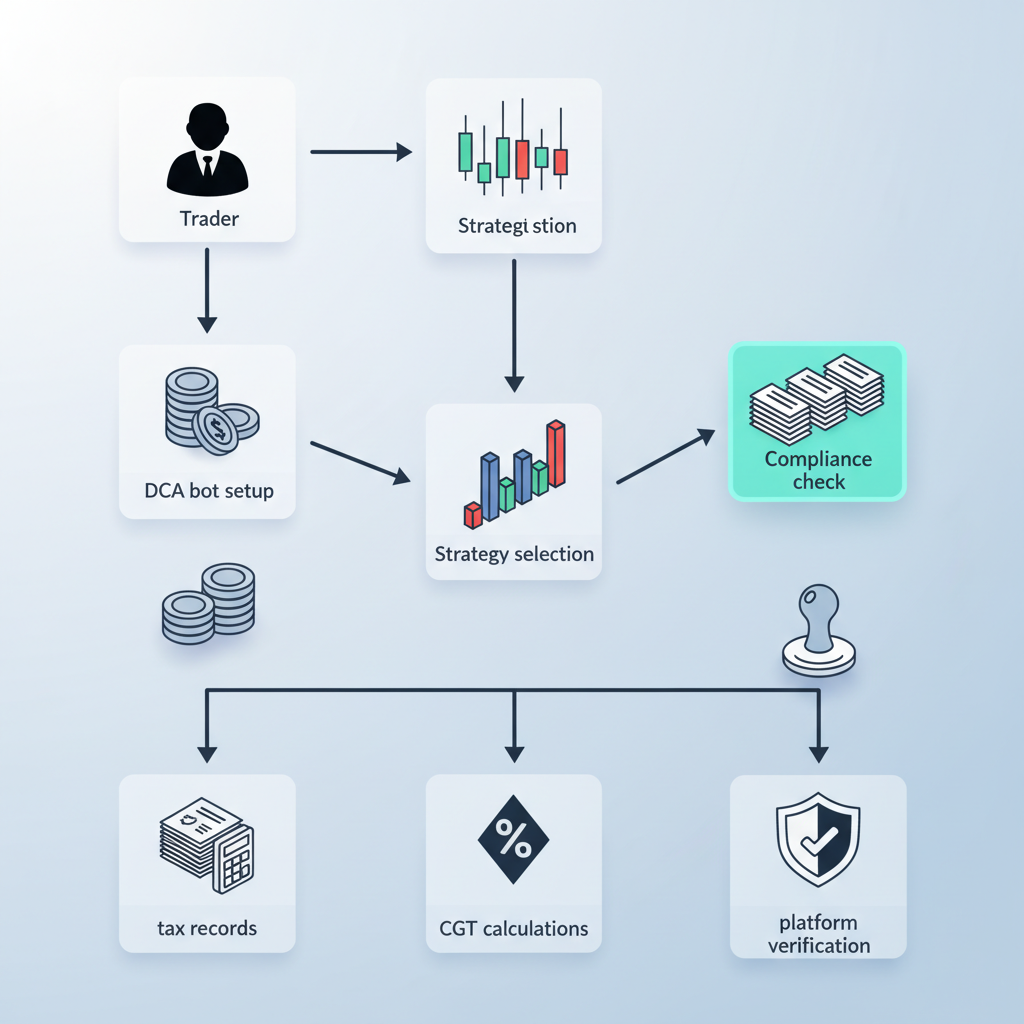
Algorithmic crypto trading is the use of software to execute buy and sell orders automatically, based on pre-programmed rules. The bot does not feel nervous at 3am when Bitcoin drops 8%. It just follows the logic you built, or the logic someone else built and you subscribed to.
At the basic end, that might be a simple grid bot buying every time BTC drops $500 from a reference price. At the complex end, you have quantitative strategies reading order book depth, volatility indices, and cross-exchange price feeds simultaneously, executing dozens of trades per minute.
The core benefits are real and specific: execution speed measured in milliseconds rather than the time it takes you to unlock your phone; no emotional override when a position moves against you; 24/7 coverage of markets that do not close on weekends; and the ability to backtest a strategy against years of historical price data before risking a dollar.
It is worth distinguishing between fully automated bots (which execute without any human confirmation) and semi-automated signal-based systems (which flag a trade and let you approve it). Both count as algorithmic trading in the broad sense, but they carry different operational risks.
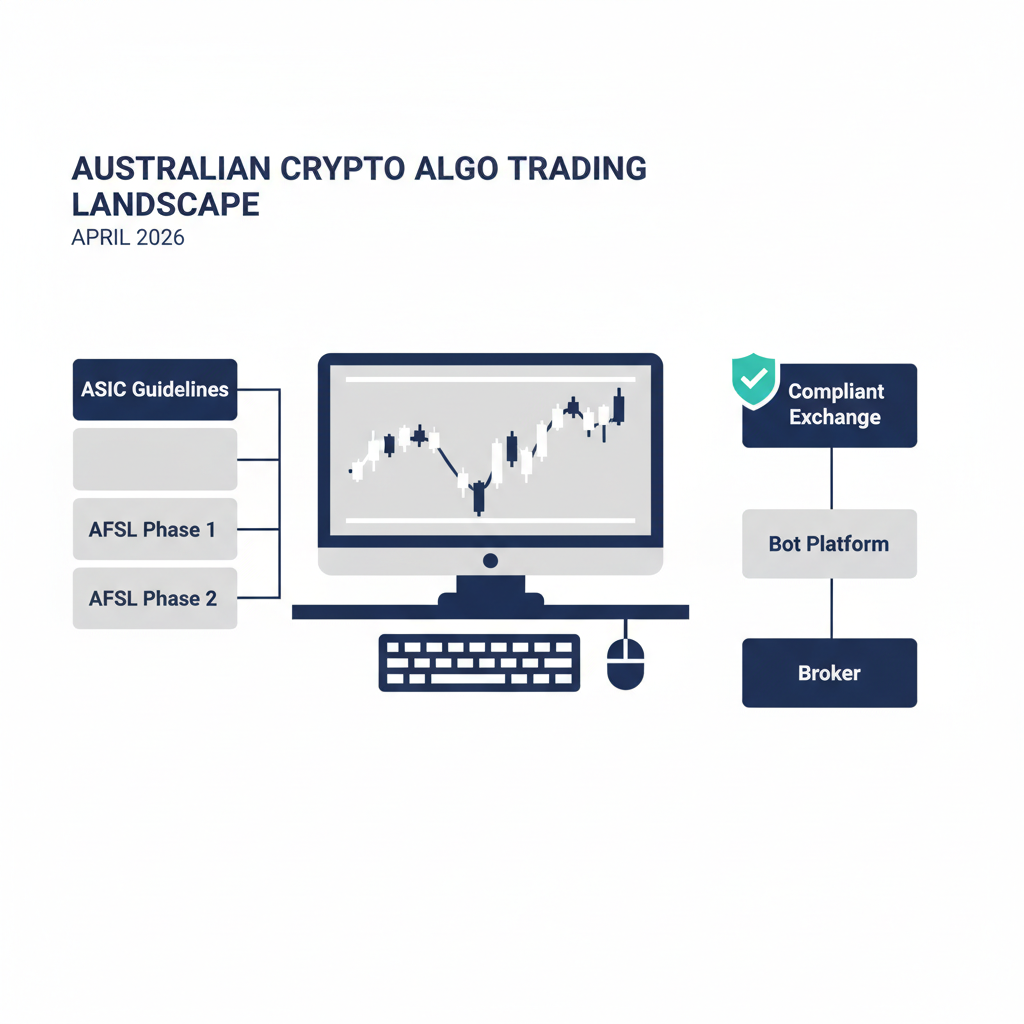
The Australian regulatory backdrop as of 2026 makes platform selection more consequential than it used to be. Since April 1, 2026, crypto exchanges and custody providers operating in Australia must hold an AFSL from ASIC and meet custody standards comparable to what a bank faces. AUSTRAC registration under the AML/CTF Act 2006 was already mandatory, and that requirement has not softened.
CryptoAlgo.com.au sits in this space as an Australian-focused algo trading platform. It does not service US investors, which is a typical compliance measure for platforms registered under Australian law rather than with the SEC or CFTC.
How Crypto Algo Trading Works: Core Mechanics
The technical plumbing underneath every trading bot is an API connection. Exchanges like Swyftx, Independent Reserve, and Kraken publish APIs that allow external software to read market data and submit orders on your behalf. You generate an API key on the exchange, paste it into your bot platform, and the bot can then trade your account within whatever permissions you grant it.
The strategy logic itself has three basic components: trigger conditions (what market signal fires the trade), order types (market, limit, stop-loss, take-profit), and risk parameters (maximum position size, maximum drawdown before the strategy pauses). Getting all three right matters. A strategy with good triggers but no sensible position sizing can still blow up an account.
Backtesting is where you run that strategy logic against historical price data to see how it would have performed. Most serious platforms offer this. The caveat worth keeping in mind: historical performance does not guarantee future results, and crypto markets in 2025 behaved differently to crypto markets in 2021. Strategy decay is a genuine risk, not a disclaimer.
Paper trading, available on platforms like Cryptohopper, lets you run a strategy in real-time against live prices but without real capital. It is the sensible step between backtesting and going live.
Latency matters more in crypto than most traders assume. If your bot is hosted on a server in Sydney and the exchange’s matching engine is in Tokyo, there is round-trip latency that can affect fill quality, particularly on high-frequency strategies. Most retail algo traders are not operating at a scale where this is decisive, but it is worth understanding.
The 24/7 nature of crypto markets is genuinely one of the strongest arguments for automation. Equities close at 4pm. Bitcoin does not. Manual traders either watch screens through the night or miss moves. A properly configured bot does neither.
Common Crypto Algo Trading Strategies Explained
Understanding what a strategy actually does matters before you subscribe to one or build your own. Here are the main categories you will encounter.
Trend-Following
These strategies try to identify momentum and ride it. Typically they use moving averages (for example, a 50-day crossing above a 200-day) or breakout signals (price clearing a defined resistance level) to enter a position, then trail a stop-loss as the trend extends. They work well in trending markets and perform poorly in choppy, sideways conditions, which crypto spends a surprising amount of time in.
Mean Reversion
Mean reversion assumes prices oscillate around a statistical average and bets on a return to that average after an extreme move. If BTC/AUD drops 15% in four hours, a mean reversion bot might buy on the assumption that a partial recovery is statistically likely. This works until it does not, and a genuine breakdown looks identical to an opportunity in the early stages.
Arbitrage
Arbitrage exploits price differences for the same asset across different exchanges. BTC might trade at $142,000 AUD on CoinSpot and $142,400 on Binance at the same moment. Buy on one, sell on the other, pocket the spread. In practice, by the time you account for transfer times, withdrawal fees, and the milliseconds it takes to execute both legs, the opportunity is often smaller than it appears. Pure cross-exchange arbitrage at scale requires very low latency infrastructure.
Grid Trading
Grid bots place a ladder of buy orders below the current price and sell orders above it, at fixed intervals. Every time price bounces through the grid, the bot collects the spread between adjacent orders. It generates consistent small profits in ranging markets and can accumulate significant losses if price breaks cleanly out of the grid range in one direction.
Market-Making
More complex and capital-intensive, market-making strategies post both buy and sell orders simultaneously to earn the bid-ask spread, similar to what professional liquidity providers do. This requires deep order books and careful management of inventory risk.
No strategy guarantees profit. Market conditions change, correlations break down, and a backtest that looked excellent on 2023 data may not survive 2026 conditions. That is not a disclosure boilerplate, it is the single most important thing to understand before committing real capital.
Australian Regulation: ASIC, AUSTRAC and the 2026 AFSL Rules
The regulatory environment for crypto algo trading Australia has shifted materially in the past twelve months, and ignoring the changes is not a neutral choice.
What Changed on April 1, 2026
Australia passed its first comprehensive digital asset law, and from April 1, 2026, any crypto exchange or custody provider operating in the country must obtain an AFSL from ASIC. The custody standards attached to that licence are described as “bank-grade”, meaning segregated client assets, adequate capital buffers, and documented risk management frameworks. Platforms have a six-month transition window, but the direction is unambiguous.
This is not theoretical tightening. In December 2025, a Federal Court ordered the liquidation of NGS Crypto and associated companies for operating without a licence. Hundreds of Australians lost money. That case was a concrete demonstration of what regulatory non-compliance looks like in practice, not just on paper.
AUSTRAC Registration
Separate to the AFSL requirement, every crypto exchange operating in Australia must be registered with AUSTRAC under the AML/CTF Act 2006. AUSTRAC is Australia’s financial intelligence unit, and crypto exchanges are classified as Digital Currency Exchange providers under its oversight.
On April 2, 2026, AUSTRAC launched a searchable public VASP (Virtual Asset Service Provider) register. This is genuinely useful. Before depositing funds anywhere, you can search the register and confirm whether the platform is listed. If it is not, that is a serious warning sign.
ASIC’s Enforcement Track Record
ASIC removed 615 cryptocurrency investment scam websites in the year to August 2024. That number speaks to the volume of fake algo trading platforms and fraudulent “managed” crypto services operating in Australia. The platforms advertising guaranteed returns on automated strategies are a significant proportion of those 615.
How to Verify a Platform
Check the AUSTRAC VASP register, check ASIC Connect for the AFSL number, and cross-reference both before funding an account. For Australian-registered platforms like CryptoAlgo.com.au, the exclusion of US investors is itself a signal of compliance-minded operation: servicing US persons without the appropriate licences creates regulatory exposure that legitimate platforms avoid.
[INTERNAL LINK PLACEHOLDER: “AUSTRAC registered exchanges” → best-crypto-exchanges-australia]
Crypto Algo Trading Tax in Australia: What You Need to Know
The ATO’s position on crypto has been consistent for several years now. Every disposal of a cryptocurrency triggers a CGT event. For algo traders, that means every completed trade, not just the final exit from a position, is potentially a taxable event.
CGT vs Ordinary Income
The critical distinction for algorithmic crypto trading Australia is frequency and intent. If you are making hundreds of trades per month through a bot, the ATO will likely classify you as carrying on a business of trading. In that case, your profits are assessable as ordinary income, not capital gains, and the 50% CGT discount that applies to assets held longer than 12 months does not apply.
Even if you are not classified as a business trader, the 50% discount is largely irrelevant for algo strategies anyway. The whole point of most algo approaches is active, frequent trading. Few positions will be held for more than 12 months.
Crypto-to-Crypto Swaps
This is where algo traders running multi-asset strategies often get caught out. Swapping BTC for ETH is a disposal of BTC and is a taxable event at the AUD value of the BTC at the time of the swap. If your bot is rotating between assets based on momentum signals, it could be triggering dozens of taxable disposals per week. Each one needs a cost base and a disposal value recorded in AUD.
Staking and Yield Strategies
If your algo strategy involves staking or yield-generating components, the income received is taxed at your marginal rate when you receive it, not when you sell the asset. That income then forms part of the cost base of the tokens received.
Record-Keeping Requirements
The ATO requires records to be kept for five years. For each trade, you need the date, the AUD value at the time of the trade, the quantity of crypto, and wallet addresses where relevant. For a high-frequency algo strategy, this can run to thousands of records per financial year.
Manual record-keeping is not realistic at that scale. I have been using Koinly for a couple of years now and it handles the API import from Australian exchanges cleanly, including cost base calculations using both FIFO and other ATO-accepted methods. CoinLedger is another solid option. Either is significantly less painful than a spreadsheet when your bot has fired 2,000 trades in a quarter.
Transferring crypto between wallets you own is not a taxable event, but you still need records to prove ownership of both wallets if the ATO ever asks.
[INTERNAL LINK PLACEHOLDER: “Australian crypto tax guide” → crypto-tax-australia]
Banking Restrictions Affecting Crypto Algo Traders in Australia
The friction between Australian banks and crypto is real, and for algo traders it creates operational problems that go beyond inconvenience.
CBA and Bank Australia have imposed monthly transaction caps of around $10,000 to certain crypto exchanges. If your strategy requires moving $30,000 into an exchange to capitalise on a position, a $10,000 monthly cap makes that impossible through those banks. Westpac has implemented anti-scam protections that block or delay payments to some exchanges, particularly those that are offshore or not on the AUSTRAC register.
ANZ and St George do not have explicit published caps for standard accounts, but large or unfamiliar transfers will frequently trigger fraud checks and delays. I have had transfers held for 48 hours while a bank’s fraud team reviewed them, which, when you are trying to fund a time-sensitive algo position, is the same as a blocked transfer in practical terms.
In February 2026, Coinbase filed a formal complaint to the Australian parliament, accusing major banks of systematically denying financial services to legitimate crypto businesses. The complaint used the term “debanking” and described it as a systemic problem affecting the sector’s competitiveness, not just individual cases.
For algo traders, the practical mitigation is straightforward: use AUSTRAC-registered, AFSL-licensed Australian exchanges. Banks apply less friction to transfers to regulated local exchanges than to offshore or unregistered platforms. PayID is faster than EFT for AUD deposits, and some exchanges process PayID deposits in under five minutes, which matters when you are trying to fund a position quickly.
[INTERNAL LINK PLACEHOLDER: “AUD crypto deposits” → how-to-buy-crypto-australia]
Risks of Crypto Algo Trading: What Australian Investors Must Consider
Algo trading is not a passive investment. It is active trading with automated execution, and the risk profile reflects that.
Market and Technical Risk
Volatile crypto prices can amplify losses quickly when a strategy is running at scale or with any form of margin. A 20% price drop in four hours is not unusual in this market, and a bot following a trend strategy might add to a losing position before its stop-loss fires. Technical risk is separate: API failures, exchange downtime, and bot software errors can all cause unintended trades, missed exits, or duplicate orders. These are not theoretical, they happen.
Strategy Decay and Security Risk
A strategy that backtested beautifully on 2022 or 2023 data may perform poorly in 2026 market conditions. Correlations change. Volatility regimes shift. Markets that were trending become ranging. Regular review of strategy performance is necessary, not optional.
Security risk is specific to algo trading in a way that does not apply to manual investors. Your bot requires an API key with trading permissions attached to your exchange account. If that key is leaked through phishing, malware, or a compromised device, someone else can trade your account. Use IP whitelisting on API keys where the exchange supports it, and never grant withdrawal permissions to a bot’s API key.
Regulatory and Scam Risk
The NGS Crypto liquidation in December 2025 is the clearest recent example of regulatory risk. Funds held on a platform operating without a licence may not be recoverable when that platform is shut down. ASIC’s removal of 615 scam sites in a single year tells you how many fake algo trading platforms are actively targeting Australians.
Liquidity risk is also relevant for strategies running on smaller altcoin pairs. Thin order books mean a bot’s own orders can move the price against itself, particularly on larger position sizes.
Always verify AUSTRAC registration and AFSL status before depositing. Always.
Frequently Asked Questions
Is crypto algo trading legal in Australia?
Yes. Algorithmic crypto trading is legal in Australia. The platform you use must be registered with AUSTRAC and, as of April 2026, must hold or be in the process of obtaining an AFSL from ASIC. There are no restrictions on individual traders using automated strategies.
Are crypto-to-crypto trades taxable in Australia?
Yes. The ATO treats every crypto-to-crypto swap as a disposal event. If your bot swaps BTC for ETH, that is a disposal of BTC at the AUD value at the time of the swap, and a CGT event is triggered regardless of whether you converted anything to Australian dollars.
How do I reduce my tax burden as an algo trader?
You cannot avoid the CGT event on each disposal, but accurate record-keeping ensures you are not overpaying. Make sure your cost base calculations are correct. If you are classified as a business trader, some operational expenses (software subscriptions, data feeds) may be deductible. Speak to a tax accountant who understands crypto before lodging.
What is the difference between AUSTRAC registration and an AFSL?
AUSTRAC registration is an AML/CTF obligation, focused on preventing money laundering. An AFSL is issued by ASIC and governs financial services standards, including client money handling and custody. From April 2026, legitimate Australian crypto exchanges must have both.
Can algo trading strategies really beat the market?
Some can, for some periods. None do so reliably forever. Strategy decay is real: what worked in a bull trend may lose money in a ranging market. Backtesting shows what a strategy would have done, not what it will do.