Crypto Algo Trading Strategies Australia: The Full 2026 Guide
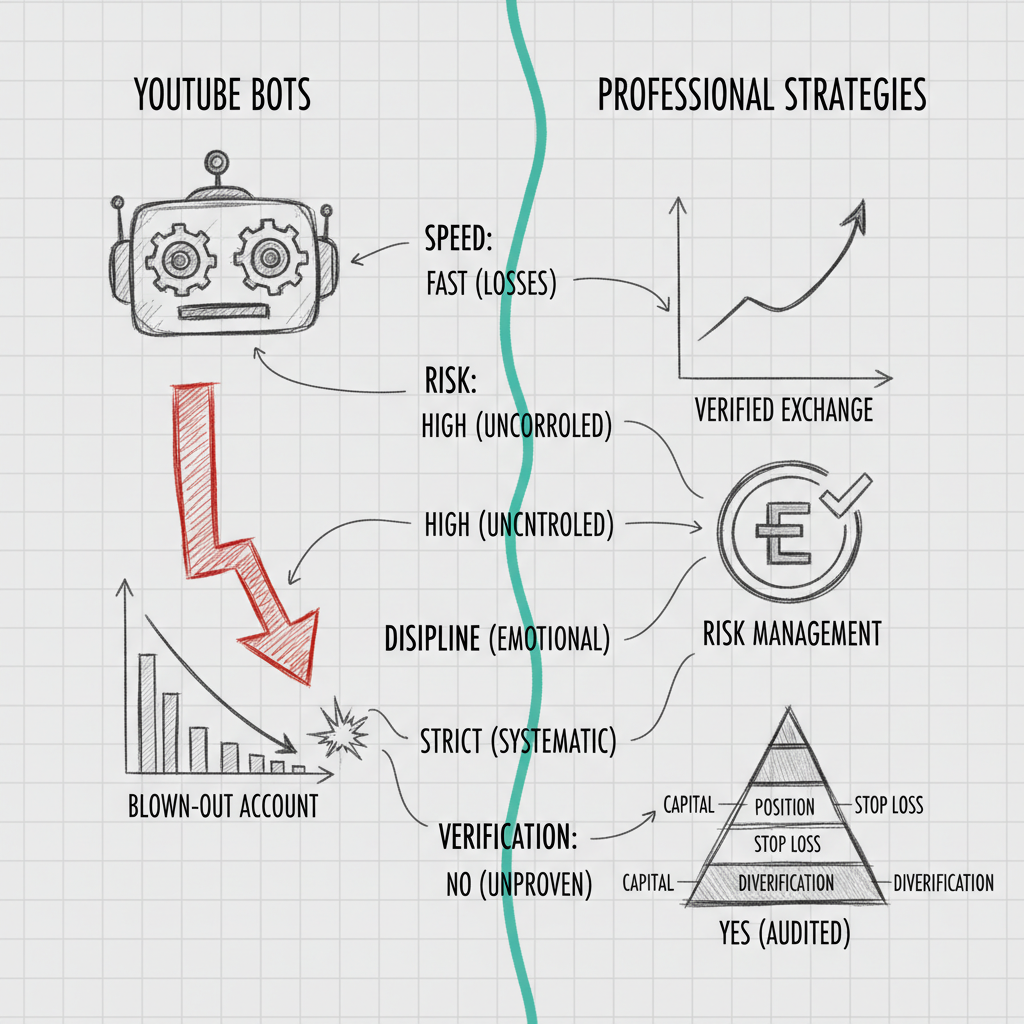
Crypto algo trading strategies Australia traders are actually using in 2026 look nothing like the “set and forget” systems sold on YouTube. I have watched too many people blow accounts with bots they did not understand, running on exchanges they never verified. This guide covers how algorithmic trading works in practice, which strategies suit which market conditions, what the Australian regulatory picture actually looks like after AUSTRAC’s April 2026 VASP register went live, and which platforms are worth your time.
> TL;DR
> Crypto algo trading strategies automate buy and sell decisions using pre-programmed rules, letting Australian traders execute faster, more disciplined trades across 24/7 markets. Common approaches include trend-following, arbitrage, mean reversion, and momentum trading. Success depends on sound logic, strict risk management, realistic expectations, and choosing a platform that is AUSTRAC-registered and suited to your goals.
What Are Crypto Algo Trading Strategies? An Australian Overview
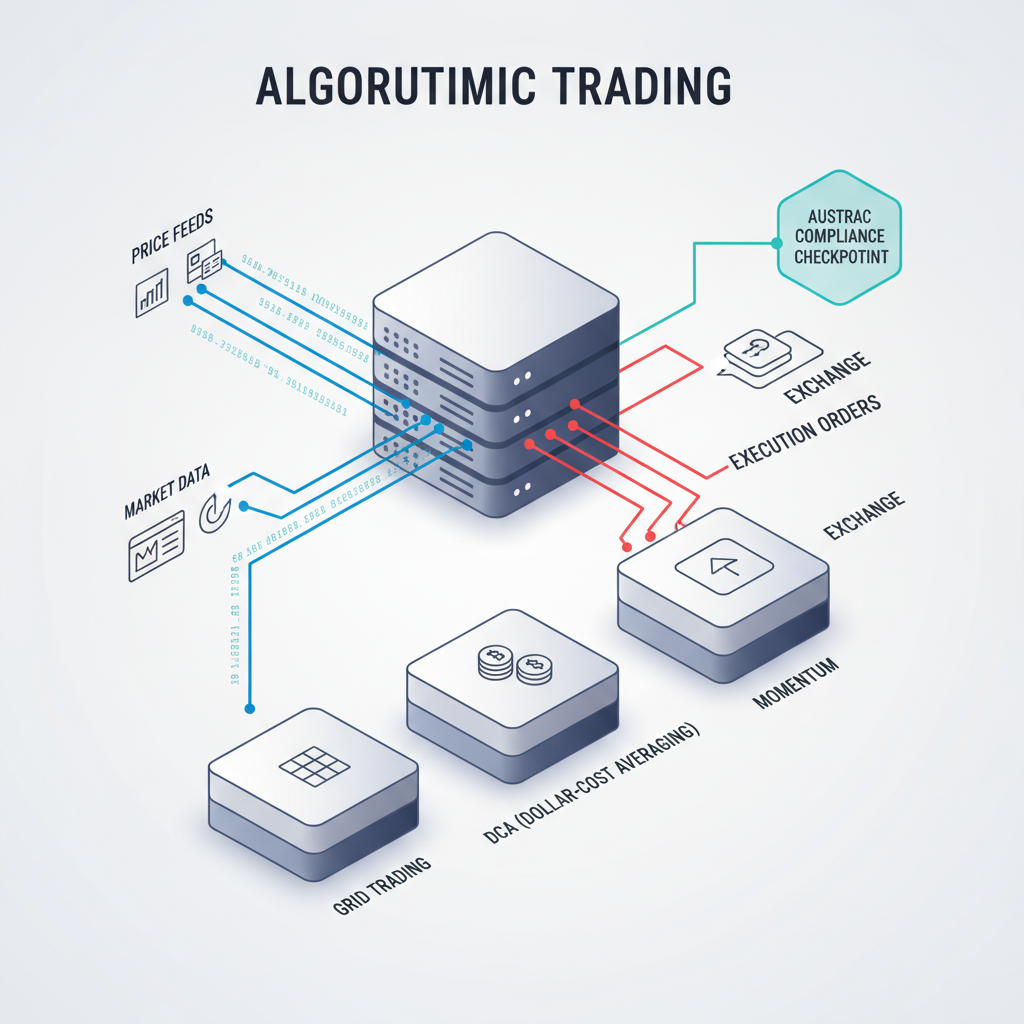
Algorithmic trading means using pre-programmed rules to automatically execute trades based on conditions you define, things like price crossing a moving average, volume spiking above a threshold, or a spread between two exchanges exceeding a target percentage. The algorithm checks those conditions continuously and fires orders without you touching a keyboard.
Crypto markets suit this approach particularly well. Unlike the ASX, which closes at 4pm Sydney time, crypto runs around the clock every day of the year. Bitcoin does not take Christmas off, and neither does volatility. A human trader who sleeps eight hours a night is structurally blind to roughly a third of all price action. An algorithm is not.
The other draw is consistency. Manual traders second-guess themselves. They cut winners early, hold losers too long, and skip entries because they had a bad week. A well-built algorithm does none of that. It applies the same rules at 3am on a Tuesday as it does at midday on a Friday.
That said, crypto algo trading strategies in Australia operate within a real regulatory framework. AUSTRAC requires every digital currency exchange (DCE) operating in Australia to register and meet anti-money laundering (AML) and counter-terrorism financing (CTF) obligations. ASIC sits alongside that, focused on scam prevention and market conduct. Both agencies have become considerably more active in the past two years, which matters when you are choosing where to run your bot.
The important caveat: none of this makes success automatic. A poorly constructed algorithm can lose money faster than a human trader because it executes its bad logic at machine speed. The strategies below are starting points, not guarantees.
Key Benefits of Algorithmic Trading in the Australian Crypto Market
The speed advantage is real and it compounds. When a breakout triggers on BTC/AUD at 2am, a human who happens to be awake still takes seconds to assess the chart, open the order form, and submit. An algorithm does it in milliseconds. In liquid markets that difference is small. In fast-moving conditions or arbitrage situations, it is the entire edge.
Discipline is the underrated benefit. I have been using Swyftx since 2022 and the number of times I manually overrode a sensible plan during the 2022 bear market is embarrassing in retrospect. An algorithm has no ego. It does not panic sell after watching a position drop 15% overnight, and it does not chase a pump because crypto Twitter is euphoric. The rules run as written, every time.
Multi-market monitoring is something no individual trader can replicate manually. A bot can watch 40 trading pairs across three exchanges simultaneously and act on all of them. A human watching the same setup would miss most signals and exhaust themselves trying.
The 24/7 availability angle is specific to crypto in a way that does not apply to ASX equities or most traditional assets. Algo trading on stocks via Interactive Brokers still hits the same market-hours wall. In crypto, your strategy can run during the Asian session, the European open, and the US session without you doing anything. For Australian traders in AEDT, that is particularly useful because a lot of meaningful US-driven crypto moves happen between midnight and 6am local time.
The Main Types of Crypto Algo Trading Strategies Explained
Trend-Following
This is the most widely used approach and the easiest to implement. The basic version: buy when price closes above a moving average, sell when it closes below. More sophisticated versions layer in multiple timeframes, ADX filters, or ATR-based position sizing to reduce false signals in choppy markets.
Trend-following works best during strong directional moves, which crypto delivers regularly. The problem is that crypto also spends extended periods ranging, and a pure trend-following system bleeds slowly during those phases. You need to either accept the drawdowns as the cost of catching the big moves, or add a volatility or range filter to reduce trading when conditions are unfavourable.
Arbitrage
Arbitrage exploits price differences between exchanges or between related pairs. If ETH/AUD is trading at $4,200 on one exchange and $4,215 on another simultaneously, a fast enough system can buy on the cheaper side and sell on the more expensive side for a near risk-free profit.
The catch: execution speed and fees matter enormously. A 0.3% round-trip fee structure eliminates a $15 spread on a $4,200 asset before you account for slippage or transfer times. Genuine arbitrage at retail level is harder than it looks, and the truly profitable opportunities are captured by institutional systems operating at much lower latency. Statistical arbitrage between correlated pairs (ETH and BTC, for example) is more accessible but carries more risk.
Mean Reversion
Mean reversion assumes that prices which have moved significantly from their historical average will eventually return to it. In ranging markets, buying the dip to the lower Bollinger Band and selling the rip to the upper band is a reasonable mechanical approach.
This strategy struggles badly in trending markets. If Bitcoin decides to go from $80,000 to $120,000 in a straight line, a mean reversion system will short every new high and get destroyed. Market regime detection, knowing whether you are in a trending or ranging environment before applying the strategy, is what separates functional mean reversion systems from expensive lessons.
Momentum Trading
Momentum strategies ride strong directional moves rather than predicting reversals. When a coin breaks out on high volume with strong rate-of-change readings, a momentum algorithm enters and holds until the momentum signal weakens. Crypto is well-suited to this because the asset class produces some of the strongest momentum moves of any liquid market.
The risk is getting caught in a false breakout or a rapid reversal. Position sizing and stop placement matter more in momentum trading than in slower mean reversion approaches.
Market Making and High-Frequency Trading
Market making involves placing simultaneous buy and sell limit orders on both sides of the order book to capture the spread repeatedly. It requires deep liquidity, very low fees (maker rebates help), and infrastructure capable of updating quotes constantly. For most retail Australian traders, this is not practically accessible.
High-frequency trading (HFT) requires co-location, institutional-grade infrastructure, and access that retail platforms simply do not provide. If someone is selling you an “HFT bot” for $99 a month, what they are selling you is not HFT.
No single strategy wins in all market conditions. A sensible approach is either to pick one strategy and apply it only in the conditions where it performs, or to run multiple uncorrelated strategies and let the portfolio smooth out the rough patches.
Backtesting and Over-Optimisation: What Australian Traders Need to Know
Backtesting runs your strategy against historical price data to see how it would have performed. Before you risk a single AUD in live markets, you should know roughly what your strategy’s drawdown profile looks like, how it performed during the 2022 bear market, and whether it has any edge at all. Skipping this step is how people end up discovering a bot’s flaws with real money.
The danger everyone underestimates is over-optimisation, sometimes called curve-fitting. If you run an optimisation that tests every combination of parameters and picks the one that produced the best backtest returns, you have probably tuned your strategy to the specific noise in that historical dataset rather than to any underlying market structure. The result is a strategy that looks excellent on paper and falls apart immediately in live trading.
The tell is specificity. A strategy that works with a 14-period RSI threshold of 67.3 and a 23-period moving average is probably curve-fitted. One that works across a reasonable range of parameters (say, RSI thresholds between 60 and 70, moving average periods between 18 and 28) is more likely capturing something real.
Walk-forward testing and out-of-sample validation are the standard fixes. Walk-forward testing means optimising on one period of data and testing on the next period you did not use for optimisation, then repeating across multiple windows. Out-of-sample validation means holding back a portion of your data entirely during optimisation and only checking it once you have finalised your parameters. If the strategy falls apart on the held-back data, it was curve-fitted. Past performance does not guarantee future results regardless, but at least you have done due diligence.
Platforms that support backtesting for Australian traders include TradingView (Pine Script strategies), Cryptohopper, Bitsgap, and Interactive Brokers Australia for broader asset classes.
[INTERNAL LINK PLACEHOLDER: “backtesting crypto strategies” → guide/backtesting-crypto-australia]
Transaction Costs, Fees, and Slippage: The Hidden Drag on Algo Returns
A strategy that looks profitable before fees often is not afterwards. This matters more in algo trading than manual trading because you are executing more frequently, and costs compound.
Most Australian exchanges operate on a maker/taker model. Maker orders (limit orders that add liquidity to the order book) attract lower fees, typically 0.1% to 0.25%. Taker orders (market orders that remove liquidity) run higher, generally 0.2% to 0.5%. If your algo fires market orders every time it triggers, you are paying taker fees on every single trade.
CoinSpot is a practical example worth understanding. Their market orders and OTC trades cost 0.1%, which is competitive. Their instant buy/sell/swap costs 1%. An algo strategy using the instant buy function on CoinSpot would need to generate more than 1% per trade just to break even on fees alone, which eliminates most strategies immediately.
Swyftx starts at a 0.6% spread on BTC/AUD. That is workable for lower-frequency strategies but brutal for anything that trades dozens of times per day.
Slippage is separate from fees and often ignored. Slippage is the difference between the price you expected when your algo triggered and the price you actually received when the order filled. In thin order books or during fast-moving markets, a market order for a meaningful size can move the price against you by 0.5% or more before it fills. Your backtest, which almost certainly assumed perfect fills at the trigger price, will look much better than live results.
Funding rates apply to perpetual futures positions held overnight. If your algo runs a leveraged long position through multiple overnight periods, the funding rate (which can run to 0.01% to 0.1% per eight hours during heated market conditions) adds up to a meaningful cost that is easy to miss in simplified backtests.
AUD deposits via PayID are generally free across Australian exchanges. Withdrawals are mostly free too, but always check the specific platform’s current fee schedule before committing.
[INTERNAL LINK PLACEHOLDER: “Australian crypto exchange fees” → best-crypto-exchanges-australia]
Australian Regulation of Crypto Algo Trading: AUSTRAC, ASIC, and Your Obligations
This section is not optional reading. The NGS Crypto case should be a warning that sits in the back of every Australian crypto trader’s mind.
In December 2025, the Federal Court ordered the liquidation of NGS Crypto and associated companies after they were found to be operating without a licence. Investors had put in $40.2 million. Liquidators found $4.6 million. The rest is effectively gone. This was not a sophisticated hack or an unforeseeable market collapse. It was a company operating outside the regulatory framework, and Australian investors paid for it.
AUSTRAC Requirements
Every digital currency exchange operating in Australia must be registered with AUSTRAC as a DCE. Registration is not optional and is not a rubber stamp. Registered exchanges must maintain AML/CTF programmes, conduct customer due diligence, keep records, and report suspicious matters. AUSTRAC launched a searchable public register for virtual asset service providers in April 2026. Use it. Before you deposit funds on any platform or connect a bot to an exchange’s API, check that the exchange appears on the register.
AUSTRAC fined Cryptolink $56,340 in October 2025 for compliance breaches related to their crypto ATM operations. The agency has been increasingly active, and the message is clear: the “crypto is unregulated” narrative is out of date in Australia.
ASIC’s Role
ASIC’s focus is on investment product conduct and scam prevention. Since July 2023 they have removed 615 crypto-related scam websites. If you are evaluating an algo trading platform you have not heard of, checking ASIC’s investor alert list takes two minutes and has saved people a lot of money.
Tax Obligations
Every crypto trade you make, including every trade your bot executes, is a taxable event under Australian tax law. CGT applies to disposals, and if your algo fires 500 trades a month, you have 500 CGT events to account for. Platforms like Koinly or CryptoTaxCalculator can ingest exchange API data and produce ATO-compatible reports. I am not a tax adviser and this is not tax advice. Speak to an accountant who understands crypto before your first EOFY with an active bot.
Australia is estimated to be missing out on $17 billion annually in gains from tokenised markets without clearer regulatory frameworks. The direction of travel is toward more regulation, not less. Building compliance habits now costs less than cleaning up problems later.
Top Platforms and Tools for Crypto Algo Trading in Australia
AUSTRAC-Registered Exchanges with API Access
Kraken is the platform I would start with for serious algo trading. Deep liquidity, a well-documented REST and WebSocket API, competitive fees, and AUD deposits and withdrawals via bank transfer. Their professional interface suits traders who are not looking for hand-holding.
Independent Reserve is an Australian-founded exchange with a tiered fee structure starting at 0.5% that decreases with volume. They have been around since 2013, support SMSFs, and have a solid API. Fees are not the lowest in the market, but the platform is reliable and local.
CoinSpot works well for lower-frequency strategies given their 0.1% market order fees. API documentation exists but is less sophisticated than Kraken’s. Better suited to simpler bots than complex multi-leg strategies.
Swyftx has over 420 assets and a user-friendly API, which makes it useful if you want exposure to altcoin strategies. The 0.6% spread is a constraint for high-frequency approaches.
Coinbase Australia and KuCoin Australia both offer API access and are AUSTRAC-registered. KuCoin has broader market depth for altcoins. Coinbase is more conservative in its asset selection but has strong liquidity on major pairs.
Dedicated Algo Trading Platforms
Cryptohopper is the most established bot platform for retail Australian traders. It offers a strategy marketplace (useful if you do not want to build from scratch), backtesting tools, dollar-cost averaging, market-making, and arbitrage modules. Subscription-based pricing. It connects to most major exchanges via API.
Bitsgap specialises in grid bots and arbitrage, with cross-exchange price tracking built in. Grid bots work reasonably well in ranging markets, which is part of why the platform has a following. The interface is cleaner than Cryptohopper’s.
Coinrule takes a no-code approach. You build strategies using “if-then” rule logic without writing a line of code. The simplicity is the point. It is not going to build you a sophisticated multi-signal strategy, but it lets you automate basic rules quickly.
TradersPost integrates with TradingView and TrendSpider to route automated signals directly to exchange orders. If you already build strategies in Pine Script on TradingView, this is a natural extension.
Broader Platform Options
cTrader is worth knowing if you trade crypto CFDs or want to run cBots on forex alongside crypto. The cBot framework is